Federal Republic of Germany (FRG) Police - Motorcycle Shield
Federal Republic of Germany Police Motorcycle Shield
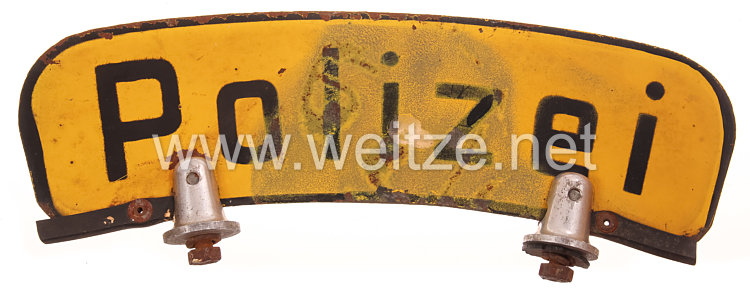
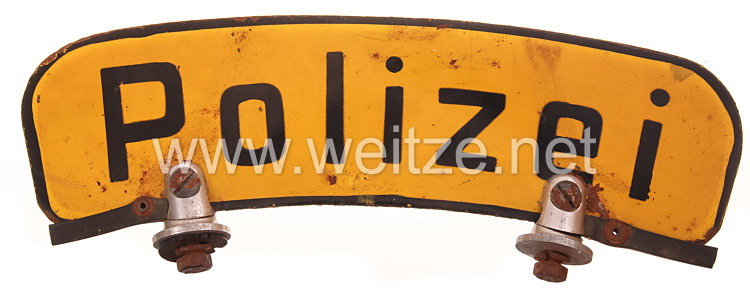
The object in question is a police motorcycle shield (Krad-Schild) from the era of the Federal Republic of Germany, painted on both sides with a length of 24 centimeters. Such shields represent an important aspect of German police history and the development of motorized police work in the post-war period.
Historical Context and Development
Following the founding of the Federal Republic of Germany in 1949, police forces in the individual federal states had to be reorganized and re-equipped. According to the federal principle, police authority rested with the states, which led to different equipment and markings. Motorcycles played a central role in mobile police work in the early Federal Republic, particularly for traffic surveillance, escort services, and rapid response operations.
The 1950s and 1960s marked an intensive motorization phase for the German police. Motorcycles were more cost-effective than automobiles while simultaneously offering the necessary mobility and maneuverability in increasing traffic. Manufacturers such as BMW, Zündapp, DKW and later foreign brands supplied motorcycles to various police authorities.
Function and Significance of Motorcycle Shields
Police motorcycle shields served several important purposes. Primarily, they were sovereign insignia that clearly identified the vehicle as a police vehicle, thereby granting it special rights in traffic. The double-sided painting enabled visibility from both directions, which was essential for traffic safety and immediate recognition.
The shields were typically attached to the front fender or on special mounts on the handlebars. They usually bore the inscription “POLIZEI” in white letters on a green background, although exact colors and designs could vary by federal state. Some states used additional coats of arms or specific state identifications.
Technical Design and Manufacturing
The production of such shields followed precise specifications from the respective police authorities. Double-sided painting was technically demanding and had to be weather-resistant, lightfast, and impact-resistant. Metal shields were usually used, which were primed, painted multiple times, and sometimes lettered using stencil techniques. The standardized length of approximately 24 centimeters corresponded to the common mounting options on the police motorcycle models used at the time.
Operational Context of Police Motorcycles
Police motorcycles were employed in various areas. The traffic police used them intensively for speed controls and traffic regulation. During state visits and official occasions, police motorcycles formed escorts. Motorized police units were also indispensable at major events and demonstrations.
The police motorcycle squads enjoyed high prestige and placed special demands on their riders. These had to complete special training and demonstrate particular driving skills. The equipment of motorcycles was continuously modernized, with identification through shields remaining a constant element.
Change and Modernization
Over the decades, the identification of police vehicles changed. While simple shields dominated in the early years of the Federal Republic, reflective materials, blue lights, and more modern lettering techniques were introduced later. The classic motorcycle shields were increasingly replaced by more elaborate paint jobs directly on vehicle parts or by modern decals.
Nevertheless, traditional shields remained in use until the 1970s and 1980s, especially at smaller police stations or in rural areas. The transition to more uniform identification standards occurred gradually and was closely linked to the general modernization and partial standardization of police equipment.
Collector Value and Historical Significance
Today, originally preserved police motorcycle shields are sought-after collector's items that offer an authentic insight into German police history. They document the technical and organizational development of police work and are testimonies to the federal diversity in the Federal Republic. For collectors of police memorabilia, motorcycle enthusiasts, and local historians, they represent valuable historical artifacts that represent a long-gone era of police work.