Weimar Republic Reichswehr Ammunition Pouch for the Gewehr 98
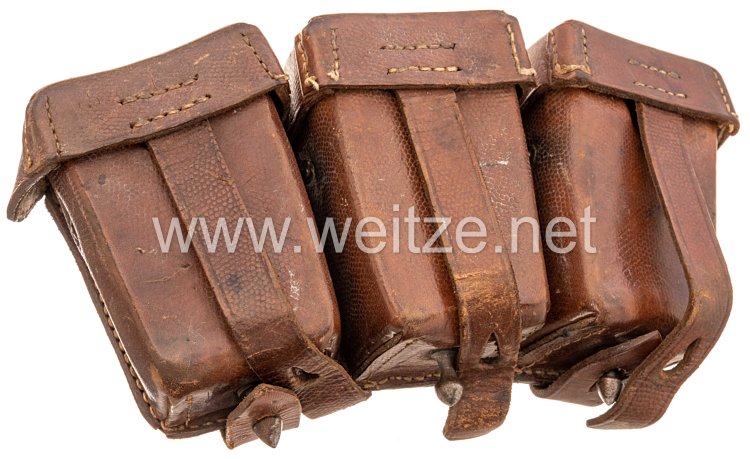
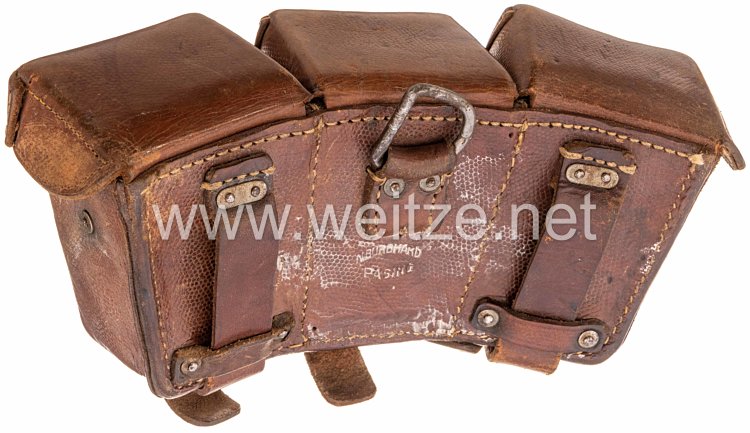
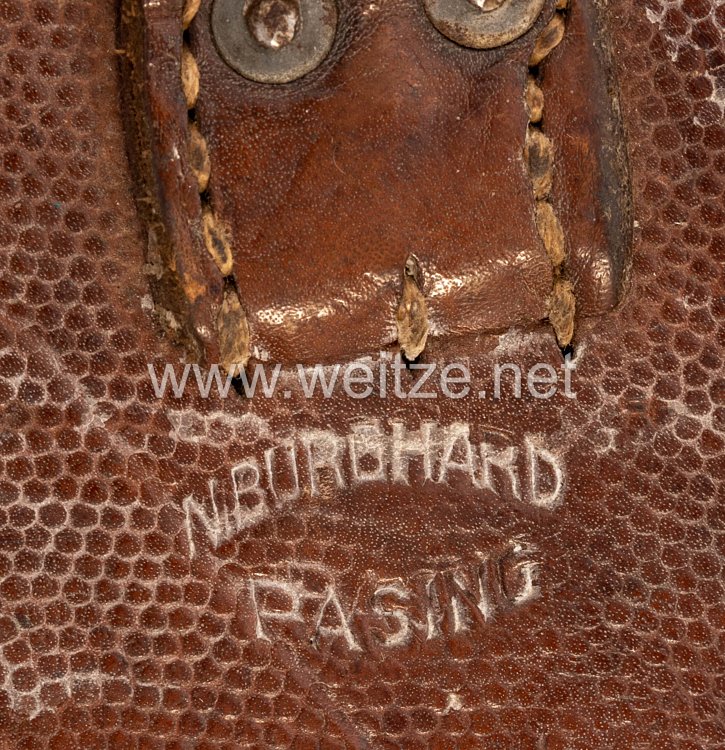
The cartridge pouch for the Gewehr 98 from 1923 represents a characteristic piece of equipment from the Reichswehr during the Weimar Republic. This specific specimen was manufactured by N. Burghard in Pasing, then an independent municipality west of Munich, which was later incorporated into Munich in 1938.
Following the end of World War I and the signing of the Treaty of Versailles in June 1919, Germany was subjected to substantial military restrictions. According to Article 160 of the treaty, the German Army was limited to only 100,000 men, called the Reichswehr. Despite this drastic reduction in troop strength, this new, smaller army still required standardized equipment and armament.
The Gewehr 98 (full designation: Gewehr 98 Mauser) remained the standard weapon of the German infantry during the Reichswehr era. This bolt-action rifle chambered in 7.92 × 57 mm, developed by Paul Mauser, was introduced in 1898 and had proven itself millions of times during World War I. The continued use of this weapon in the Reichswehr made sense both for practical and economic reasons, as large stocks were available.
The cartridge pouch for the Gewehr 98 was an essential element of infantry equipment. It was worn on the belt and served to store ammunition in the form of stripper clips. Each stripper clip contained five cartridges that could be quickly loaded into the rifle's magazine. A soldier's typical equipment usually included three such cartridge pouches, which could hold a total of 60 rounds of ammunition.
The brown pebbled leather used was characteristic of German military equipment from this period. Unlike the later Wehrmacht, which increasingly used black leather, the Reichswehr largely retained the brown leather equipment from the Imperial era. The tanning and processing of the leather followed military specifications that ensured durability and weather resistance.
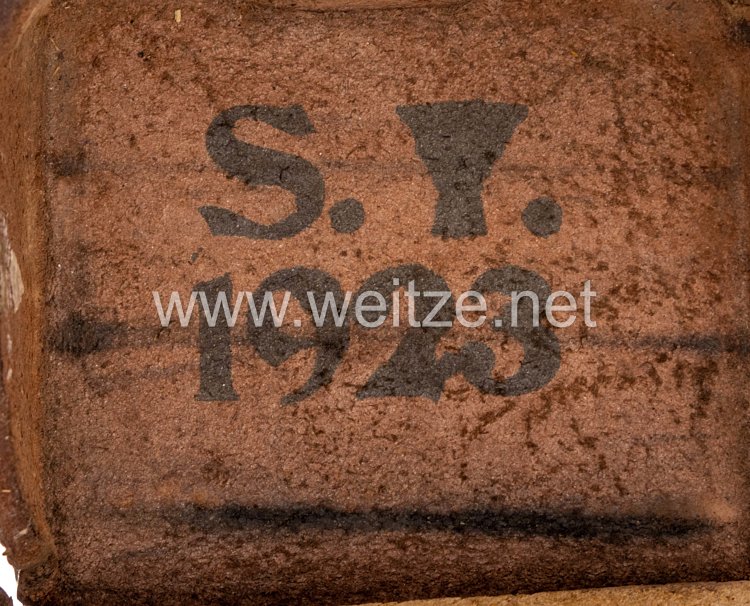
The stamp “S.Y. 1923” in the lid indicates acceptance by military inspectors. These stamps served quality control purposes and enabled traceability of equipment items. The year 1923 falls within a particularly turbulent phase of the Weimar Republic: the year was marked by the Occupation of the Ruhr by French and Belgian troops, hyperinflation, and various political unrest, including the Hitler-Ludendorff Putsch in Munich in November.
The company N. Burghard in Pasing was one of several suppliers manufacturing leather equipment for the Reichswehr. The decentralization of production among various manufacturers was typical of German military procurement and was intended to provide both economic and strategic advantages. Pasing had a certain tradition in leather processing and was located near several Reichswehr garrisons in Bavaria.
The construction of the cartridge pouch followed established patterns: a rectangular housing with a hinged lid secured by one or more leather straps with buckles or studs. On the back were loops through which the belt could be threaded. The workmanship had to be robust, as the pouches were subjected to considerable stress in service.
The Reichswehr itself was a purely professional army consisting of long-serving soldiers. Officers and non-commissioned officers were carefully selected and formed the backbone of this small but well-trained force. Despite the restrictions of the Treaty of Versailles, the Reichswehr leadership endeavored to maintain a high level of training.
Equipment items such as this cartridge pouch were part of a standardized system designated as “Kammerstück” (chamber piece). This designation meant that the item was official property of the military chamber and was only provided to soldiers for the duration of their service. The careful marking and recording of all equipment parts was typical of the Prussian-German military tradition.
After the Nazi seizure of power in 1933 and the systematic rearmament of the Wehrmacht from 1935 onward, Reichswehr equipment was gradually replaced or modified. However, many cartridge pouches remained in use for years, as the rapid expansion of the armed forces made immediate complete re-equipping impossible.
Today, such equipment pieces from the Reichswehr period are important military-historical objects that provide insights into the interwar period and the development of the German armed forces. They document both the continuity of military traditions and the specific circumstances of German history between 1919 and 1933.