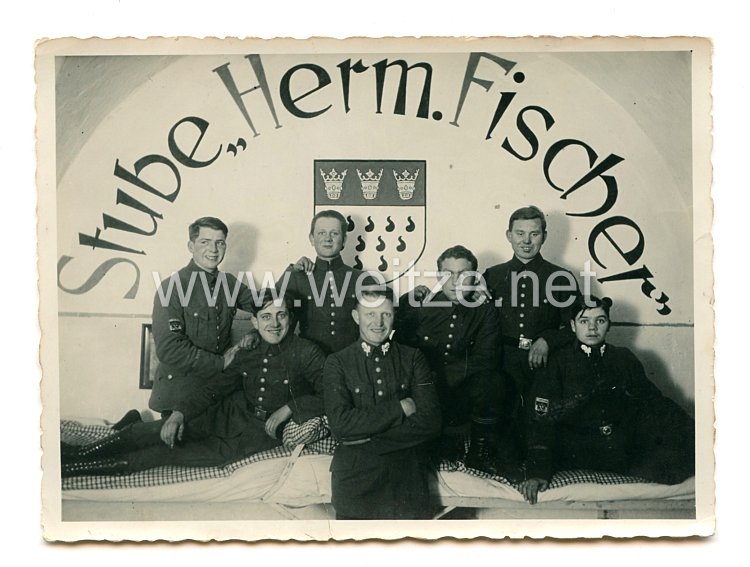
Weimar Republic Photograph, Group Portrait of a Regional Defense Association

Dimensions approximately 12 x 9 cm. Used condition.
339904
10,00

Weimar Republic Photograph, Group Portrait of a Regional Defense Association

This group photograph from the era of the Weimar Republic (1918-1933) documents the members of a regional association (Landesverband) and represents an important historical document from Germany's interwar period. With dimensions of approximately 12 x 9 cm, it corresponds to the typical formats of private and official photographs from this epoch.

After the end of World War I in November 1918 and the abdication of Kaiser Wilhelm II, an entirely new political and military system emerged in Germany. The Treaty of Versailles of 1919 imposed drastic restrictions on German military power: the new Reichswehr was limited to only 100,000 men, general conscription was prohibited, and large portions of military equipment had to be destroyed or surrendered.

In this context, numerous paramilitary organizations and veterans' associations emerged, representing various political orientations. The term “Landesverband” refers to regional organizational structures organized at the state level. Among the most significant organizations of the Weimar Republic were the Stahlhelm - League of Front Soldiers, founded in 1918, the Reichsbanner Black-Red-Gold (1924), the Communist Party's Red Front Fighters' League, and the NSDAP's Storm Detachment (SA).

These organizations were often structured hierarchically with local, district, and state associations. Group photographs like the present one served several purposes: they documented membership, strengthened esprit de corps and camaraderie, and were often taken on special occasions such as parades, commemorative ceremonies, or association conferences.

Photographic technology of the 1920s and early 1930s had advanced considerably compared to the pre-war period. Roll film cameras and more compact formats enabled broader documentation of everyday life. The format of approximately 12 x 9 cm suggests a contact print or small-format enlargement, typical for private collections or association archives.

The political landscape of the Weimar Republic was characterized by deep divisions. Veterans' associations and defense leagues reflected societal polarization: while conservative-monarchist groups like the Stahlhelm rejected the Republic and dreamed of revising the Treaty of Versailles, republic-loyal organizations like the Reichsbanner defended the democratic order against extremist threats from both left and right.

The uniforming and military-like organization of these associations was characteristic of the era. Despite the restrictions of the Treaty of Versailles, many Germans continued to cultivate military traditions. Group photographs in uniform-like clothing, often with badges, flags, and military insignia, expressed a persistent militarism in society.

Historically speaking, such photographs are today valuable sources for researching the political culture of the Weimar Republic. They provide insight into organizational structures, the social composition of associations, regional particularities, and the visual self-representation of these groups. The Weimar Republic was characterized by a constant struggle between democratic and anti-democratic forces, which also manifested itself in the existence and rivalry of these various associations.

The “used” condition of the photograph is not unusual for a document nearly one hundred years old and underscores its authenticity. Signs of aging, slight damage, or discoloration are typical characteristics of historical photographs that have been kept in private ownership or archives for decades.

Such group photographs are today sought-after collectibles and important research objects. They help historians better understand the complex social and political structure of Germany's first democracy and analyze the mechanisms that ultimately contributed to its collapse in 1933.

r