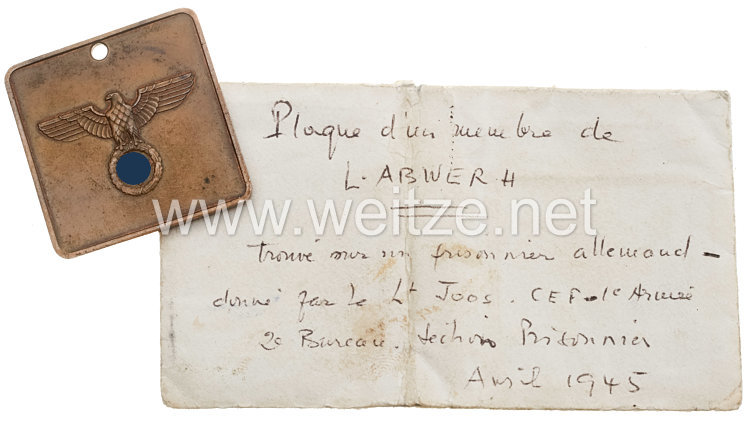
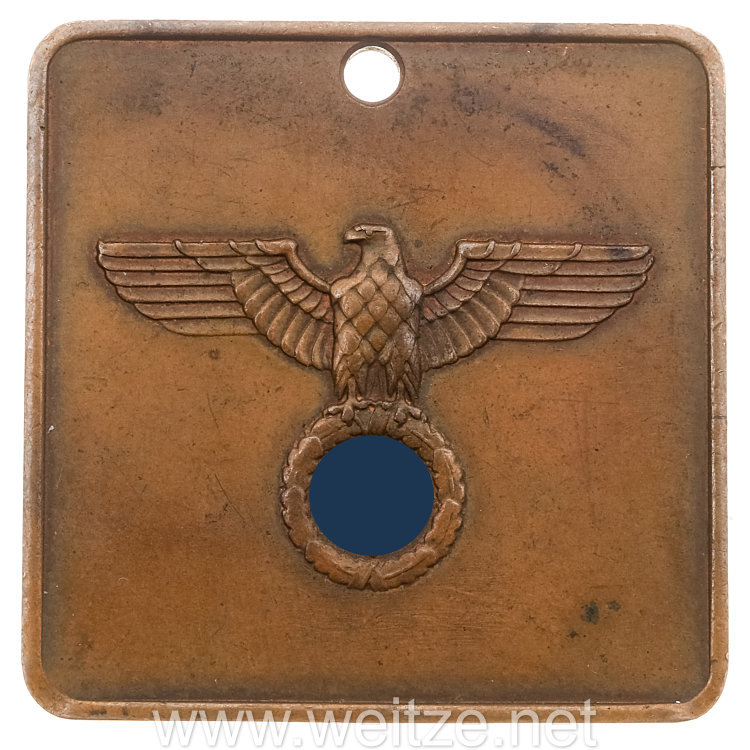
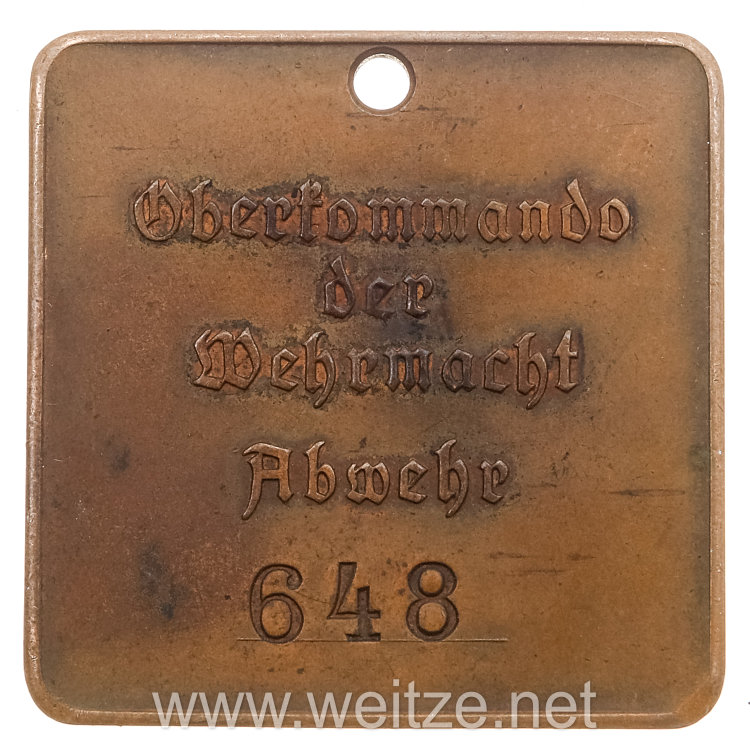
The Dienstmarke of the Oberkommando der Wehrmacht Abwehr represents one of the rarest and most historically significant identification items of the German military intelligence service during World War II. This unassuming object made of base metal alloy, stamped with the number 648, represents one of the Wehrmacht's most secretive organizations and documents the existence of an institution that stood at the center of German military intelligence operations.
The Abwehr was formed in 1920 within the Ministry of Defence as Germany's military intelligence service, initially tasked with defensive counterintelligence duties. Following the Nazi seizure of power and the massive rearmament of the Wehrmacht, the organization gained increasing importance. On February 4, 1938, a fundamental reorganization occurred when the Abwehr was placed under the newly created Oberkommando der Wehrmacht (OKW) and officially became known as the Amt Ausland/Abwehr im Oberkommando der Wehrmacht. Its headquarters was located at 76/78 Tirpitzufer in Berlin.
Under the leadership of Admiral Wilhelm Canaris, appointed Chief of the Abwehr in 1935, the organization developed into an extensive intelligence service with three main divisions: Abwehr I was responsible for intelligence gathering, Abwehr II organized sabotage operations and special operations, while Abwehr III focused on counterintelligence. Among the significant leadership figures alongside Canaris were Major General Hans Oster, chief of the Central Division from 1939 to 1944, as well as the division chiefs Colonel Hans Piekenbrock (Abwehr I), Colonel Erwin von Lahousen (Abwehr II), and Colonel Franz Eccard von Bentivegni (Abwehr III).
The Dienstmarke served to identify personnel of the Abwehr service within military and intelligence contexts. Unlike the standardized Wehrmacht Erkennungsmarke, which all soldiers wore as oval metal discs measuring 70x50mm, the Abwehr Dienstmarke was a special identification badge for members of this intelligence organization.
The history of the Abwehr took a dramatic turn when many high-ranking officers, including Canaris and Oster, became involved in resistance activities against the Nazi regime. These oppositional activities led to the dissolution of the organization in 1944. Heinrich Himmler had the Abwehr merged into the SS Reich Security Main Office (RSHA). Admiral Canaris was executed on April 9, 1945, for his involvement in the resistance.
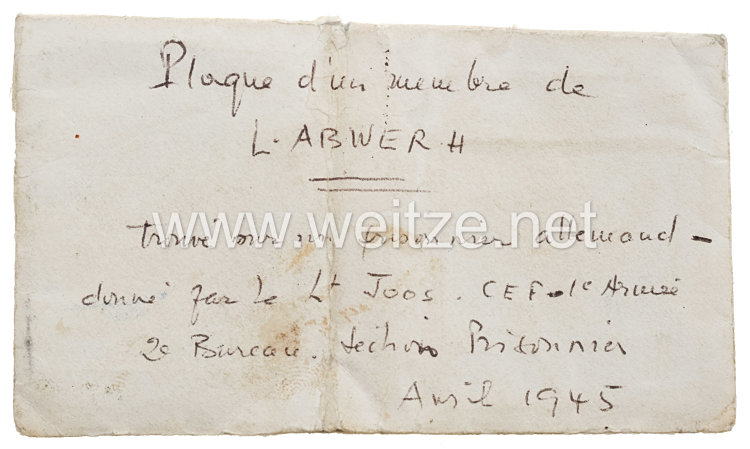
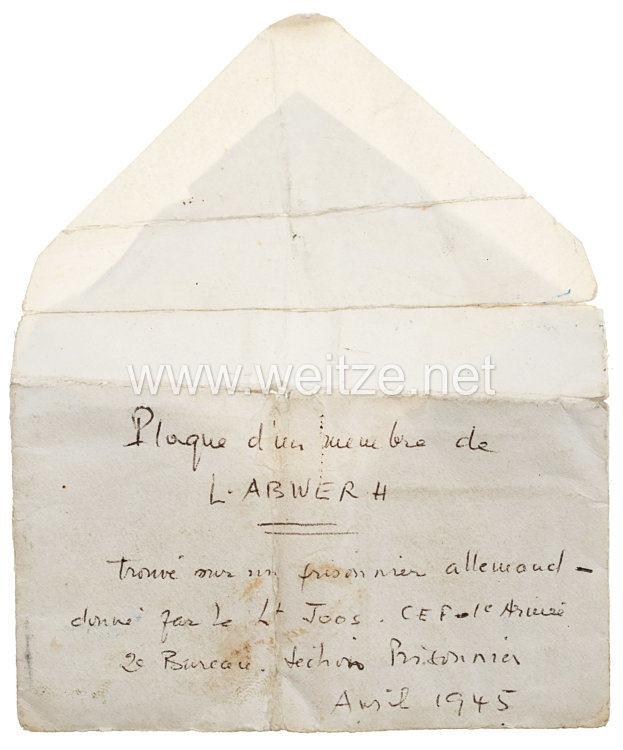
The present example possesses extraordinary provenance: it was captured in April 1945 by French forces of the 1st Army from a German prisoner and handed over to Lieutenant Joos of the 2nd Bureau, the Prisoner Section. The 2nd Bureau was traditionally responsible for intelligence services. The preserved original envelope with French inscription documents this war trophy: “Plaque d'un membre de L'Abwehr. Trouvé sur un prisonier allemand - donné par le Lt. Joos. Cef 1e Armée 2e Bureau Section Prisonier - Avril 1945.”
Following Germany's capitulation in 1945, Nazi-related items and Wehrmacht insignia were prohibited under Allied occupation laws. Such identification items became war souvenirs and later historical collector pieces. The extraordinary rarity of these service badges on the collector market underscores the significance of this object as an authentic testimony to one of the most controversial organizations in German military history.