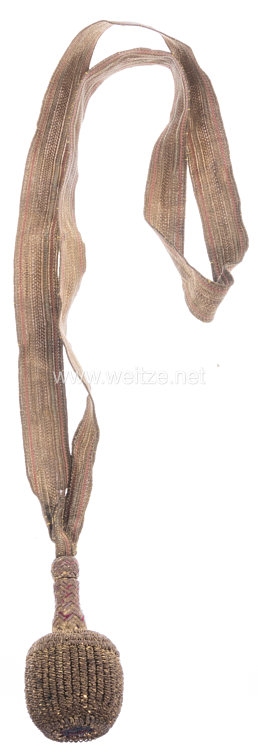
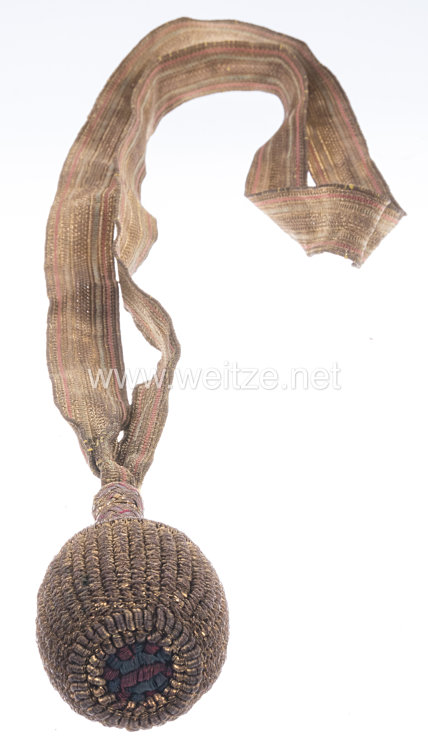
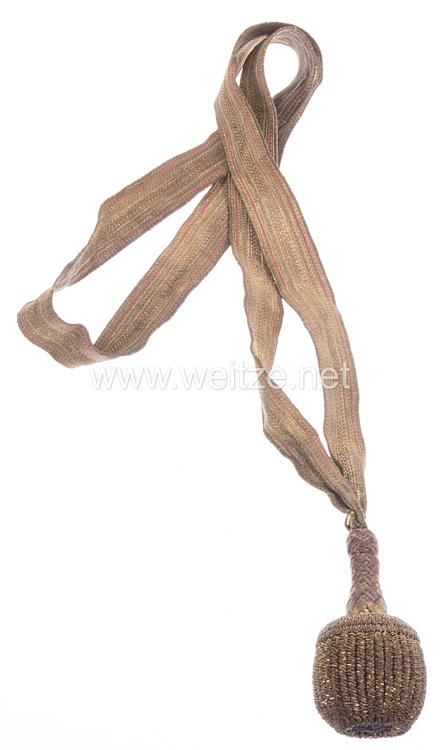
Oldenburg Sword Knot for Officers
The Portepee (sword knot) was an indispensable mark of distinction for officers in German armed forces during the 19th century. This particular example from the Grand Duchy of Oldenburg dates from around 1830 and represents a significant epoch in German military history, when the various German states maintained their own distinct military identities.
The Grand Duchy of Oldenburg was one of the smaller German federal states, yet it maintained a proud military tradition. Following the Napoleonic Wars and the Congress of Vienna in 1815, the German states reorganized their military structures within the German Confederation. During this period, uniform regulations and officers' insignia were standardized, with each state retaining its own colors and symbols.
The characteristic color combination of this Oldenburg portepee – gold with blue and red interwoven threads – was no coincidence. The colors blue and red were the traditional state colors of the Grand Duchy of Oldenburg and appeared in various badges and equipment items of the Oldenburg army. The gold band clearly identified officer rank, while ordinary soldiers and non-commissioned officers carried portepees made from other materials.
The artfully crafted golden acorn and crown of this portepee are of particular historical significance. The crown symbolized the monarchical form of government and loyalty to the Grand Duke, while the acorn stood as a traditional Germanic symbol for strength and steadfastness. The combination of these elements underscored the wearer's status as an officer in service to the Grand Duke.
The technical construction with stem, slider, and filling in red-blue followed the standard design principles of the period. The slider served to attach the portepee to the sword hilt and adjust it as needed. The filling, often made of leather or sturdy fabric, provided the necessary stability and shape to the portepee.
Around 1830, German military affairs were in a transitional phase. The experiences of the Wars of Liberation against Napoleon had led to comprehensive reforms. Under the influence of Prussian military thinkers such as Gerhard von Scharnhorst and August Neidhardt von Gneisenau, even the smaller German states modernized. However, the portepee as a rank insignia remained a constant element of military tradition.
The rarity of this object is due to several factors. First, the Oldenburg army was relatively small compared to larger German states like Prussia or Bavaria, which limited the number of officers' portepees produced. Second, many of these textile equipment items have not survived the passage of time, as they were subject to heavy wear during daily use.
The portepee was typically worn on the saber or sword, the indispensable sidearms of an officer. It served not only as decoration but also had practical functions: the loop was placed around the wrist to prevent the weapon from being lost in combat. At the same time, the portepee was an immediately recognizable rank insignia that conferred respect and authority upon its wearer.
The manufacture of such portepees was handwork of the highest level. Specialized passementiers – craftsmen who specialized in making braids, tassels, and military decorative elements – created these artistic pieces. The use of gold threads and the precise incorporation of the state colors required great craftsmanship.
The indicated condition 2 with signs of wear is quite expected for an object almost 200 years old and in no way diminishes its historical value. On the contrary: the traces of wear testify to actual use by an Oldenburg officer in the first half of the 19th century and make the piece an authentic historical witness.
Such portepees are today important study objects for military historians and collectors, as they provide insight into the uniforming, hierarchy, and aesthetics of pre-1848 German military affairs. They document the diversity of the German states before the founding of the Empire in 1871 and the significance that military tradition and symbolism held during this epoch.