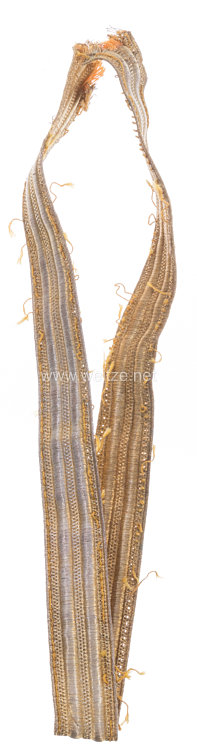
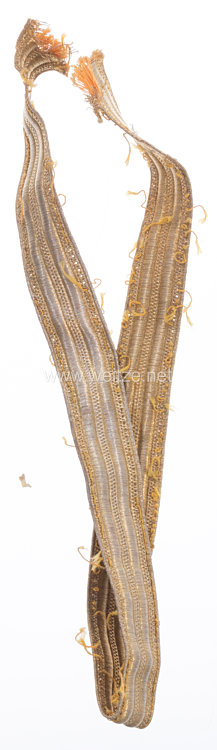
Kriegsmarine Single Sleeve Braid for a Lieutenant

Metal thread, width: approx. 153 mm, length: approx. 35 cm, removed from uniform, condition 2-
346504
20,00

Kriegsmarine Single Sleeve Braid for a Lieutenant

The present Kriegsmarine single sleeve braid for a Leutnant (Lieutenant) represents an authentic rank insignia of the German Navy during World War II. This rank badge, manufactured from metal thread, documents the complex rank identification system of the German Navy between 1935 and 1945.

The Kriegsmarine was officially established on June 1, 1935, after National Socialist Germany had rejected the restrictions of the Treaty of Versailles. With the Anglo-German Naval Agreement of June 18, 1935, the reconstruction of a German naval fleet was internationally recognized. The new Kriegsmarine initially adopted many traditions from the Imperial Navy but also developed its own uniform regulations and rank insignia.

The rank of Leutnant zur See (Lieutenant at Sea) represented the lowest commissioned officer rank in the Kriegsmarine. This position was comparable to a Lieutenant in the Army or Air Force. Leutnants zur See had typically completed their officer training at the Naval School Mürwik in Flensburg and carried considerable responsibility aboard warships, U-boats, and in shore establishments.

The sleeve braids (Ärmeltressen) were attached to the uniform jackets of naval officers on both sleeves above the cuffs. They consisted of golden-yellow metal thread sewn onto a dark blue background. For a Leutnant zur See, the insignia consisted of a medium gold braid approximately 15-16 centimeters long. The width of these sleeve braids was standardized at approximately 15 millimeters.

The manufacture of such sleeve insignia was carried out by specialized military equipment companies that had to maintain strict quality standards. The metal threads used were mostly made of gold-plated copper or brass wire spun around a textile core. This gave the braids their characteristic golden color and typical luster.

The uniform regulations of the Kriegsmarine were detailed in various dress orders (Anzugsordnungen or A.O.). The most important provisions were found in the “Dress Regulations for the Kriegsmarine” (M.Dv. No. 53), which was updated several times. These regulations precisely dictated how the sleeve braids were to be attached, what spacing was to be maintained, and on which uniform parts they could be worn.

Sleeve braids were worn on various uniform variants, including Full Dress, Service Dress, and Walking Out Dress. The dark blue uniform jacket on which these braids were mounted was the most characteristic garment of naval officers and clearly distinguished them from the field-gray uniforms of the Army.

The hierarchical structure of the Kriegsmarine was strictly organized. Above the Leutnant zur See were the Oberleutnant zur See (Senior Lieutenant, with two narrower braids), the Kapitänleutnant (Lieutenant Commander, with two medium braids), and the higher ranks up to Großadmiral (Grand Admiral). Below the Lieutenant ranked the Ensigns and Naval Cadets, who were considered officer candidates.

During the war, approximately 40,000 officers were trained in the Kriegsmarine. The casualty rate was particularly high in the U-boat service, where about 75 percent of crews did not survive. Many young Leutnants zur See served on these dangerous missions and wore their sleeve braids with pride as a sign of their officer status.

The present specimen was removed from the uniform, which was a common practice after the war's end. Many soldiers removed rank insignia from their uniforms before entering captivity or returning home to conceal their military affiliation. Other insignia were removed by collectors or kept as souvenirs.

The preservation of such military-historical objects is of great importance for research. They document not only the material aspects of military history but also social hierarchy, craftsmanship skills, and the symbolic significance of rank insignia. The relatively good condition (Condition 2-) indicates that the object was carefully preserved.

Today, authentic Kriegsmarine sleeve braids are sought-after collectors' items, valued by both military history museums and private collectors. They serve as material witnesses to a significant, albeit dark, era of German naval history and enable subsequent generations to understand the organization and structure of the Kriegsmarine.

r