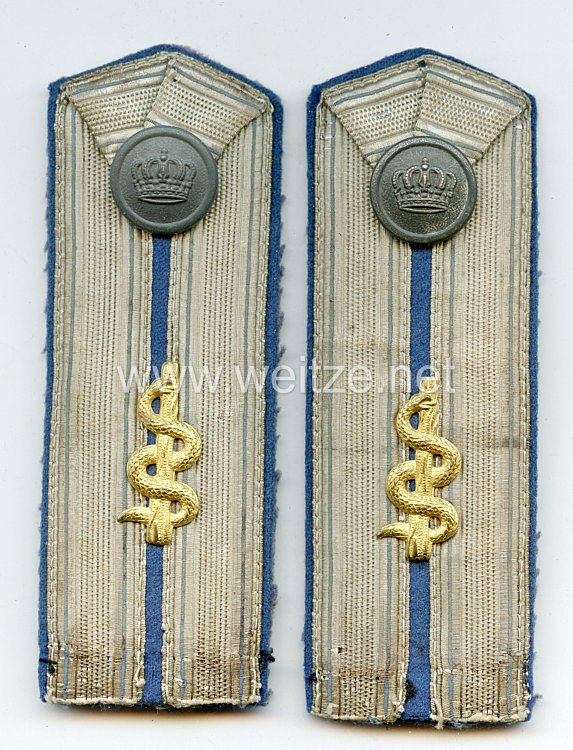
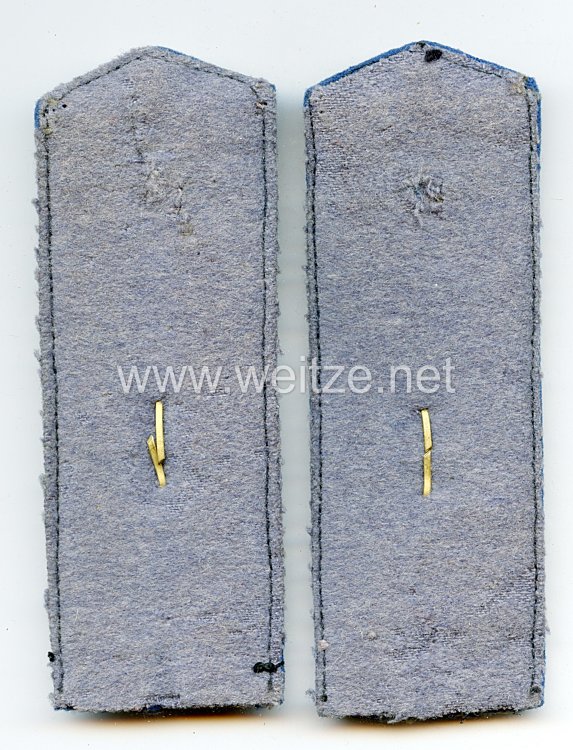
Bavaria World War I Pair of Field Gray Shoulder Straps for a Medical Sergeant
These shoulder boards of a Bavarian Feldunterarzt (Assistant Medical Officer) from World War I represent an important chapter in German military medical history. Manufactured around 1916, these rank insignia document the organizational structure and identification system of medical personnel in the Royal Bavarian Army during the Great War.
The medical service of the Bavarian Army had a long tradition and was continuously professionalized throughout the 19th century. With the introduction of universal conscription and the modernization of the armed forces after 1870/71, medical care gained increasing importance. The rank designation Feldunterarzt referred to a military medical grade positioned between ordinary medical personnel and fully qualified physicians.
The shoulder boards described here display the characteristic design for Bavarian medical personnel. The blue cloth was the traditional Waffenfarbe (branch color) of the Medical Corps in the Bavarian Army, clearly distinguishing medical personnel from other branches. The silver braids with blue piping indicate the specific rank and affiliation with the non-commissioned officer corps. The golden Aesculapian staff, the ancient symbol of healing, unmistakably identified the wearer's medical function.
The dating to around 1916 is of particular historical significance. At this time, the German Empire was in the midst of devastating trench warfare on multiple fronts. The Battle of Verdun and the Battle of the Somme in 1916 led to unprecedented casualties and placed enormous challenges on the medical service. Medical care had to be organized under the most difficult conditions, and assistant medical officers played an important role in the initial treatment of wounded soldiers.
The light gray cloth backing of the shoulder boards corresponds to the field-gray uniform that was gradually introduced in the German Army from 1910 onwards, replacing the colorful peacetime uniforms. This innovation followed military necessities of modern warfare, where camouflage and reduced visibility became vital for survival. Bavaria, however, maintained certain autonomies within the German Empire's unified army, which was reflected in uniform details.
A Feldunterarzt typically had completed basic medical training but was not a fully licensed physician. His duties included initial treatment of wounded soldiers in the field, supporting regimental doctors, supervising hygiene among troops, and organizing the transport of wounded to rear medical facilities. In the medical service hierarchy, he was subordinate to senior physicians and staff doctors but ranked above ordinary medical personnel.
The manufacture of such shoulder boards followed precise regulations of the dress code. The materials used, colors, and arrangement of insignia were strictly regulated. The silver braids were woven or embroidered from metal threads, and the Aesculapian staff was frequently made of gilded metal and sewn on. The quality of workmanship could vary depending on the manufacturer and time of production, with increasing material shortages observable toward the war's end.
The pair of shoulder boards – one for each shoulder – was attached to the field-gray uniform tunic and enabled quick identification of the wearer and his rank. This was of great importance in daily military life, but especially in the chaos of combat. Wounded soldiers needed to quickly recognize medical personnel, and superior officers had to grasp the rank structure at a glance.
After the end of World War I and the dissolution of the Royal Bavarian Army in 1918/19, such uniform items were often kept as mementos. Today they document not only military organization but also the personal fate of the men who served in the medical service, contributing to the care of countless wounded. The preservation of such objects is of great cultural-historical value for researching military history and medical services during World War I.
These shoulder boards thus represent far more than mere military insignia. They are tangible witnesses to a time when medical officers worked under extreme conditions to save lives, when the battlefields of Europe claimed millions of casualties, and when the traditional monarchies of Central Europe faced their final years. The combination of blue medical corps color, silver rank insignia, and the golden symbol of Aesculapius encapsulates the dedication of those who served humanity even amid the horror of industrial warfare.