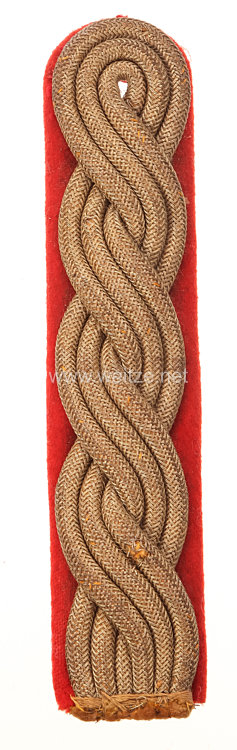
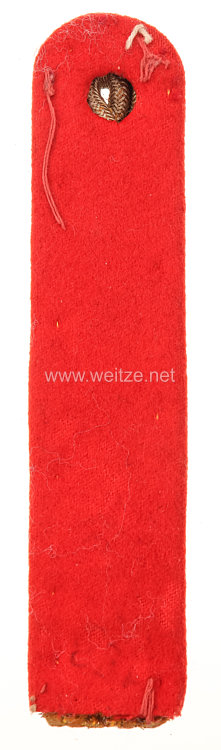
Shoulder Board for Sturmbannführer to Obersturmbannführer in the Staff of the Supreme SA Leadership
The shoulder board for Sturmbannführer to Obersturmbannführer in the Staff of the Supreme SA Leadership represents a significant rank insignia from the organizational hierarchy of the Sturmabteilung (SA) during the National Socialist period. These shoulder boards served to visually identify middle-ranking leaders within the staff structure of the highest SA command level.
The Sturmabteilung was founded in 1921 as a paramilitary combat organization of the NSDAP and developed into a mass organization with several million members by 1933. After the seizure of power and particularly after the so-called Röhm Purge of June 30, 1934, during which the SA leadership was largely eliminated, the organization increasingly lost political significance but retained its formal structure and rank system.
The ranks of Sturmbannführer and Obersturmbannführer corresponded in the SA hierarchy approximately to the military ranks of major and lieutenant colonel respectively. The Sturmbannführer commanded a Sturmbann, a unit of approximately 250 to 600 men, while the Obersturmbannführer served as deputy Standartenführer or in staff functions. Membership in the Staff of the Supreme SA Leadership signified a special position within the organization, as these officers were directly assigned to the central leadership level around the Chief of Staff of the SA.
SA shoulder boards were manufactured according to detailed uniform regulations. Special markings applied to the Staff of the Supreme SA Leadership, distinguishing these bearers from regular SA units. The base color of the shoulder boards was characteristic of the respective assignment and affiliation. Rank differences between Sturmbannführer and Obersturmbannführer were made visible through the number and arrangement of rank stars or braids.
SA uniforming followed a complex system established in the SA Service Regulations and various orders from SA leadership. After 1934, several modifications to the uniform system occurred, though the basic structure remained largely intact. The shoulder boards were worn on the brown SA uniform, which was characteristic of the organization's appearance.
Within the context of staff organization, bearers of such shoulder boards had administrative, organizational, and coordinating duties. They served in various departments of the Supreme SA Leadership, including personnel, training, administration, and other staff functions. After 1939, the SA increasingly assumed responsibilities in pre-military training and was integrated into the NS state's military fitness program.
The manufacture of such rank insignia was carried out by authorized manufacturers who produced according to regulations. Quality and execution could vary, though higher-quality versions were typically standard for staff members. The shoulder boards were attached to the shoulder straps of the uniform jacket and were an essential component of service dress.
After 1945, the SA was banned by the Allies and classified as a criminal organization. Uniform parts and insignia were largely destroyed or confiscated. Today, such objects are found in museum collections and serve for historical documentation and education about the organizational structure of the NS regime.
From a scholarly perspective, such rank insignia are important sources for researching internal hierarchies, organizational structure, and the self-perception of NS paramilitary organizations. They document the meticulous regulation of rank orders and the significance of visual status symbols within the National Socialist system of rule.