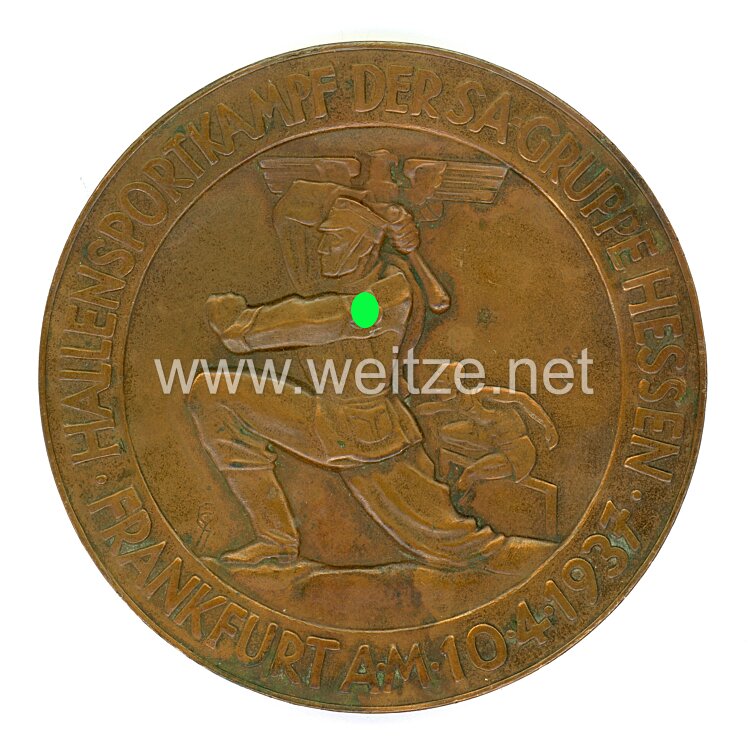
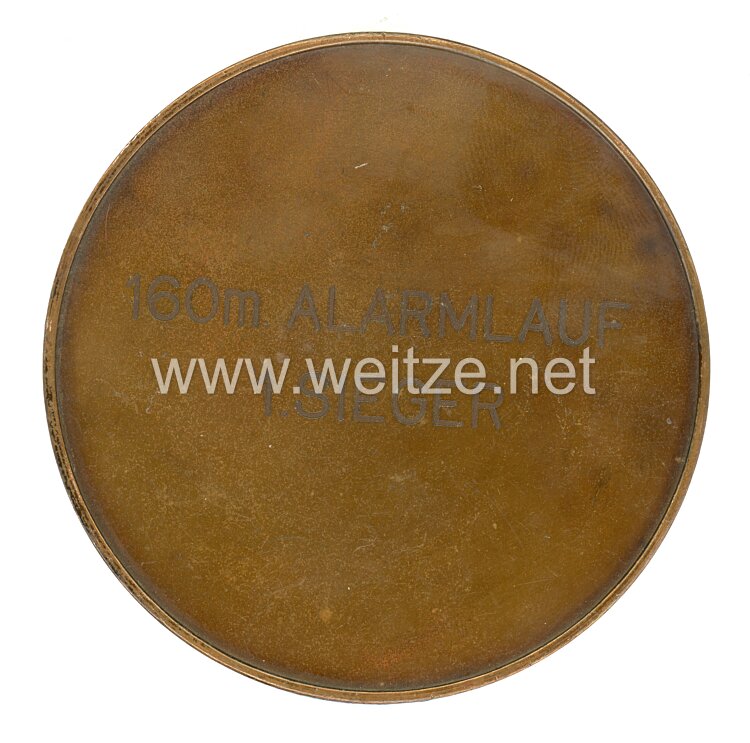
SA Non-Portable Winner's Medal “Indoor Sports Competition of SA-Gruppe Hessen Frankfurt on April 10, 1937”
This SA sports medal from 1937 represents an important aspect of National Socialist physical culture and paramilitary training in the Weimar Republic and the Third Reich. The Sturmabteilung (SA), originally founded in 1921 as a protection squad for the NSDAP, evolved into a massive paramilitary organization that reached its peak in April 1932 with over four million members.
The indoor sports competition of SA-Gruppe Hessen in Frankfurt on April 10, 1937, took place at a time when the SA had already lost considerable political significance. After the so-called “Röhm Affair” or “Night of the Long Knives” from June 30 to July 2, 1934, during which SA Chief of Staff Ernst Röhm and numerous other SA leaders were murdered, the organization had been largely stripped of its power. The SA was increasingly restricted to sports and pre-military training functions.
The SA-Gruppe Hessen was one of the regional divisions of the SA, encompassing the Hesse region with Frankfurt as an important center. These groups were subdivided into brigades, standards, storm battalions, and storm troops, conducting regular exercises, marches, and sports competitions.
The 160-meter alarm run, for which this medal was awarded as a victory prize, was a typical SA paramilitary sports exercise. The alarm run was designed to train rapid deployment readiness and combined physical fitness with military discipline. Such competitions typically included various disciplines such as cross-country runs, obstacle courses, hand grenade throwing, small-caliber and air rifle shooting, as well as various relay races.
The medal itself is made of tinted aluminum with a considerable diameter of 85 mm, which was typical for non-wearable victory medals. Unlike wearable decorations that could be attached to uniforms, these large medals were designed as commemorative pieces and trophies. The reverse engraving “160m Alarmlauf 1.Sieger” documents the specific achievement of the recipient.
The use of aluminum was common in the 1930s, as this material was inexpensive and readily available. The tinting gave the medal a bronze-like or silvered appearance. The obverse of such medals typically displays SA symbolism such as the SA emblem, swastikas, oak leaves, or depictions of SA men engaged in athletic activities.
The year 1937 marks a phase of consolidation of the Nazi regime. The SA had left its revolutionary phase behind and now functioned primarily as an instrument for pre-military training and ideological education. Sports were viewed as a means of physical conditioning and preparation for military service, which corresponded to the regime's military objectives.
Such sports competitions served multiple purposes: they promoted esprit de corps within the SA, publicly demonstrated the supposed strength and fitness of the Nazi movement, and prepared participants for military duties. The public display of strength and discipline was an important component of National Socialist propaganda.
The preservation and rating of such objects in condition 2 (very good) indicates that this medal was well maintained, possibly as a personal memento of the victor. Today, such objects are important historical documents that provide insight into the everyday culture and organizational structures of the Nazi regime.
For collectors and historians, these non-wearable medals are particularly interesting because they document local events and are often provided with engraved details that supply specific information about location, date, and achievement. They complement the understanding of the SA as an organization that, beyond its political function, also operated as a sports and recreational association.
The examination of such artifacts contributes to a more nuanced understanding of how the Nazi regime permeated daily life and how paramilitary organizations used sports and physical culture as tools for ideological indoctrination and military preparation. These medals remain tangible evidence of the systematic militarization of German society during the 1930s.