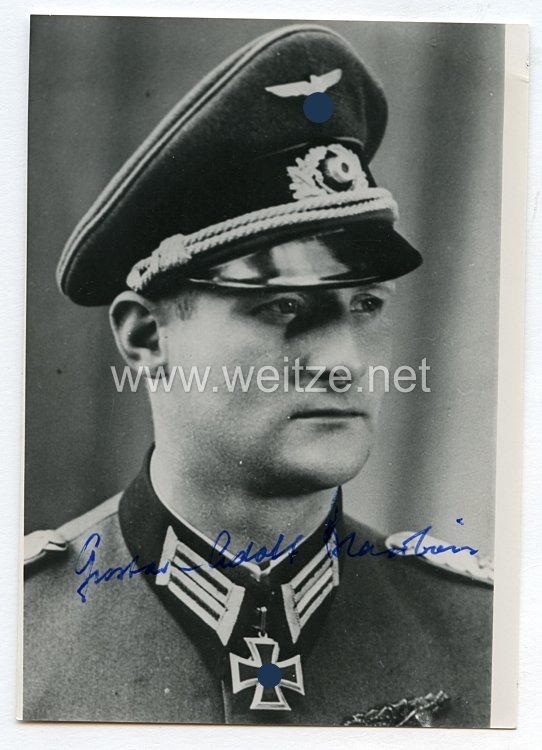
Army - Post-War Signature of Knight's Cross Recipient Gustav-Adolf Blancbois
The present post-war signature of Gustav-Adolf Blancbois, a Knight's Cross recipient of the German Wehrmacht, represents a significant category of military historical collectibles from the period after 1945. Such autographs and signed photographs became an important component of military historical research and collecting, as they represent direct personal connections to the events of World War II.
Gustav-Adolf Blancbois served during World War II in the German Wehrmacht and was awarded the Knight's Cross of the Iron Cross, one of the highest military decorations of the Third Reich. The Knight's Cross was instituted on September 1, 1939, by Adolf Hitler as a supplement to the Iron Cross and was awarded throughout the war to members of the Wehrmacht, Waffen-SS, and in exceptional cases to civilians. Approximately 7,300 individuals received this decoration in various grades.
The present photograph is a post-war print produced after 1945. This is a characteristic feature of many military historical photographs from this period. After the war's end, many former soldiers, including Knight's Cross recipients, lived in the Federal Republic of Germany and the GDR. Beginning in the 1950s, increasing interest in military historical documentation developed, and many veterans were contacted by collectors, historians, and those interested in military history.
The practice of collecting autographs of former soldiers began to establish itself in the 1960s and 1970s. Veterans' associations organized meetings where former soldiers gathered and were often willing to sign photographs or provide autographs. These signatures served various purposes: for historians, they were part of documentation and oral history; for collectors, they became coveted memorabilia; and for the veterans themselves, they were often a form of recognition of their wartime experiences.
The photograph's format (approximately 14.5 x 10.4 cm) corresponds to a common postcard size frequently used for such purposes. The designation “Condition 2” in the object description refers to the established grading system for collectibles, where Condition 1 means mint and Condition 5 heavily damaged. A Condition 2 indicates a well-preserved object with possibly minor signs of use.
In the context of the culture of remembrance in the Federal Republic of Germany, such objects occupy a complex position. The period after 1945 was characterized by different phases of dealing with the National Socialist past. In the 1950s, there was often a tendency toward glorification of military achievements, while from the 1960s onward, a more critical examination emerged. The collecting of military memorabilia always moved within this tension between historical interest and the danger of glorification.
For military historical research, such post-war documents are of limited but nevertheless existing value. They document the post-war biographies of military personnel and can provide insights into veteran networks, memory practices, and the social position of former soldiers. At the same time, they must be viewed in the context of their time of origin: they are products of the post-war period and not contemporary documents of the war itself.
The legal and ethical aspects of collecting such objects have changed over the decades. While in the early Federal Republic, wearing and displaying decorations with NS symbolism was permitted under certain conditions, legal regulations became stricter over time. However, collecting for scientific, historical, or similar purposes remains fundamentally permitted, provided it does not serve to glorify National Socialism.
In summary, this object represents a typical example of post-war memory culture and the collecting of military historical documents. It connects the personal history of an individual soldier with the larger narratives of World War II and German post-war history, and it stands as an example of the continuing engagement with this complex historical epoch.