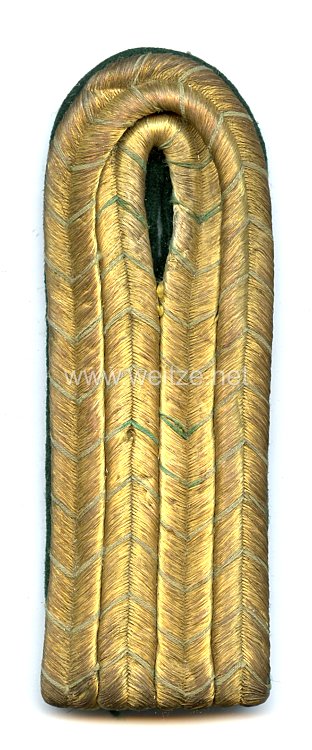
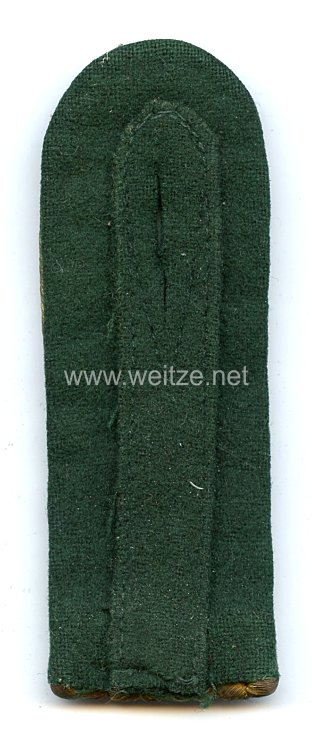
Weimar Republic Single Shoulder Board for a Customs Official
This shoulder board for a customs official of the Weimar Republic from around 1924 represents a fascinating transition in German uniform history. After the collapse of the German Empire in November 1918 and the proclamation of the Republic, all state institutions had to adapt their external symbols and uniforms to the new political order.
The Weimar Republic, which existed from 1919 to 1933, inherited from the Empire a complex system of customs authorities and border protection agencies. The customs service had a particularly important function in post-war Germany. After the Treaty of Versailles of 1919, the German armed forces were severely limited, and the Reichswehr was only allowed to comprise 100,000 men. In this context, paramilitary formations such as the Customs Border Protection units gained importance, as they effectively served as reserves for the reduced armed forces.
Shoulder boards or shoulder straps had been essential components of German uniform tradition since the 19th century. They served not only to secure equipment items but were primarily rank insignia and indicators of unit type or departmental affiliation. For customs officials, shoulder boards displayed the wearer's rank and membership in the customs service.
The year 1924 marks a phase of relative stabilization in the Weimar Republic. After the chaotic years of hyperinflation, which ended in November 1923 with the introduction of the Rentenmark, the Republic began to consolidate. During this period, uniform regulations and rank insignia for various state services were also revised and standardized.
The customs administration of the Weimar Republic was subordinate to the Reich Ministry of Finance. The customs service was divided into different areas: the regular customs service at borders and customs offices, as well as the Customs Border Protection, a barracked, militarily organized formation. The latter was particularly stationed at the eastern borders of the Reich and assumed border police functions in addition to customs duties.
The design of shoulder boards followed traditional Prussian-German patterns. Typically, they consisted of braided cords or braids in specific colors. For customs officials, green or dark green base colors were characteristic, signaling membership in the customs service. The device, which is missing from this specimen, was usually a metal emblem or number that identified the specific office or service area.
The used condition of this piece suggests actual service deployment. This is historically particularly valuable as it is not a parade piece but an authentically worn service uniform item. Many uniform parts from the Weimar Republic were later destroyed or reworked during the Nazi era, making original pieces from this period rare collector's items today.
The position as a single shoulder board is also noteworthy. Normally, shoulder boards were worn in pairs, but individual pieces frequently remained as spare parts or were discarded during uniform changes. The absence of the device could be due to later removal, possibly after the end of service or during reorganizations within the customs service.
The uniforming of customs officials in the Weimar Republic reflected the attempt to connect with Prussian traditions on one hand, while eliminating monarchical symbols on the other. Imperial emblems such as crowns were replaced by republican symbols, with the Reich Eagle motif retained in modified form.
Such uniform items document not only the military and administrative history of Germany but also the social and political upheavals of the interwar period. They are material witnesses to a transitional era in which traditional forms coexisted with new republican ideals. For collectors and historians, they offer valuable insights into the everyday culture of state institutions during Germany's first democracy.