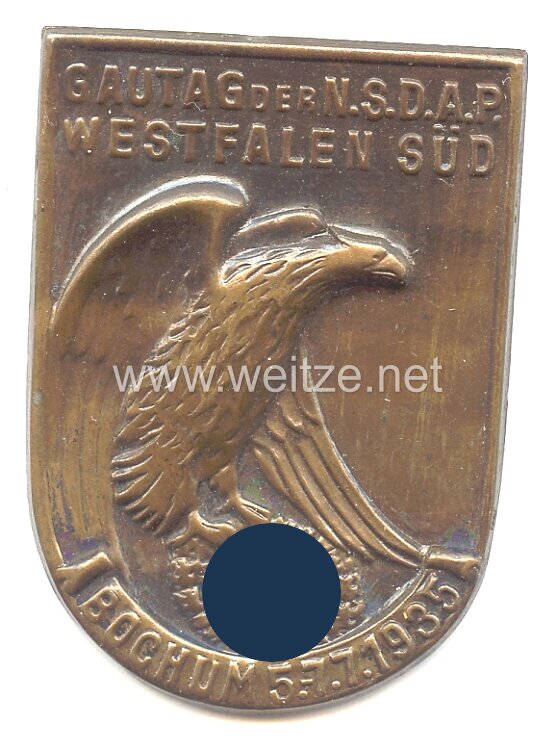
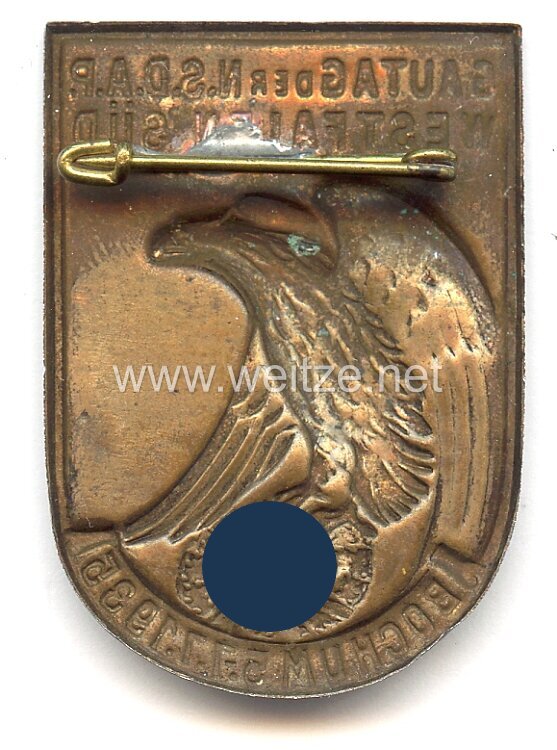
NSDAP - Gau Rally of the NSDAP Westfalen-Süd Bochum 5-7 July 1935
The badge in question documents the Gautag of the NSDAP Westfalen-Süd (Regional Party Rally of South Westphalia), which took place from July 5-7, 1935 in Bochum. Such event badges were widespread during the National Socialist period and served both to identify participants and as propaganda and memorabilia items.
The NSDAP Gaue (regional districts) formed the most important regional administrative units of the National Socialist party organization. The Gau Westfalen-Süd was created in 1933 from the original Gau Westfalen and encompassed the southern areas of the Prussian Province of Westphalia, including the Ruhr region with industrial cities such as Bochum, Dortmund, and Hagen. Josef Wagner served as Gauleiter (regional party leader) from 1932 to 1941, simultaneously holding the same position in Silesia.
The Gautage (regional party rallies) were annual large-scale events where party members and affiliated organizations of the NSDAP gathered. They served multiple purposes: ideological training, demonstration of power and unity, mobilization of supporters, and public self-representation of the party. Such events followed an established ceremonial protocol including mass marches, flag ceremonies, speeches by leading functionaries, and various propaganda presentations.
The year 1935 was politically significant for the Nazi regime. In September of that year, the infamous Nuremberg Race Laws were proclaimed. The party was in a phase of consolidating its power and increasingly coordinating all areas of society under Nazi control. Gautage such as this one in Bochum were part of this systematic penetration of society.
The described badge is made of sheet iron and features a pin for attachment to clothing. Manufacturing from sheet iron was typical for event badges of this type and period, as they could be produced inexpensively in large quantities. Unlike official party badges or decorations, which were often made from higher-quality materials, these Gautag badges were intended as temporary identification for the duration of the event.
The design of such badges typically followed National Socialist design principles and usually included symbols such as the swastika, the party eagle, as well as information about the location and date of the event. The color scheme frequently oriented itself around the party colors of red, white, and black.
The choice of Bochum as the venue was no coincidence. As a significant industrial city in the Ruhr region with its mining and steel industry, Bochum was of strategic importance to the regime. The NSDAP sought to win over and control the working class of this region, which had traditionally been a stronghold of Social Democrats and Communists.
Such event badges were issued or sold to participants and were to be worn visibly throughout the entire event. Today they document the pronounced symbolic politics and organizational structure of the Nazi regime. For collectors and historians, they are important contemporary witnesses that provide insight into the propaganda machinery and regional organization of the NSDAP.
The stated condition 2+ corresponds according to common numismatic and military-historical grading scales to a very good condition with only minimal signs of wear. This is remarkable for an almost 90-year-old object made of relatively simple material and suggests that it was either not worn frequently or carefully preserved.
The scientific and collecting engagement with such objects serves exclusively for historical documentation and research. They are material remnants of a criminal regime and help to understand and document the mechanisms of totalitarian rule and propaganda for future generations.