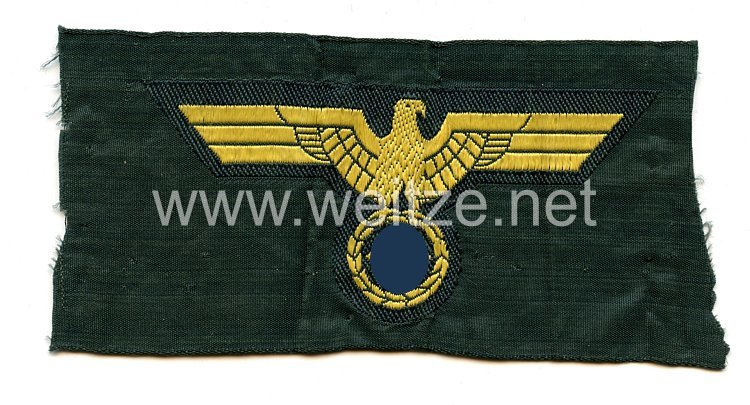
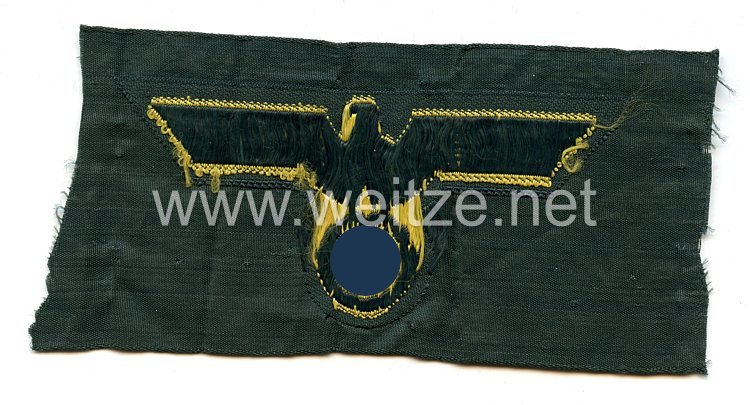
Kriegsmarine Breast Eagle for Enlisted Men Coastal Artillery - Land Units
The Kriegsmarine Breast Eagle for Enlisted Personnel of Coastal Artillery represents a characteristic badge of the German naval forces during World War II. This special breast badge was worn by enlisted ranks serving in the land units of the Kriegsmarine's coastal artillery.
The Coastal Artillery (Küstenartillerie) formed an important component of German defensive strategy during World War II. These units were responsible for defending coasts, harbors, and naval bases against enemy naval and air attacks. Unlike naval personnel serving aboard ships, members of the coastal artillery were primarily stationed on land, although they were organizationally part of the Kriegsmarine.
The present example shows the typical BeVo execution, a woven variant of the breast eagle. The company BeVo (Barmer Verband or Bandweberei) from Wuppertal was one of the most well-known manufacturers of woven insignia for the Wehrmacht and its branches. The BeVo technique enabled the mechanical production of detailed, durable badges that were more cost-effective than embroidered or metal variants.
The green base color of the badge is characteristic of the Kriegsmarine's land units. While naval personnel aboard ships wore their insignia on dark blue uniforms, the Marine's land units used green uniforms similar to Wehrmacht uniforms. This coloring provided better camouflage during land operations and visually distinguished coastal artillerymen from their comrades at sea.
The eagle itself followed the official regulations of the Kriegsmarine. The national emblem shows the Reich eagle with outstretched wings, holding a swastika in its talons. The design differed from the eagles of the Wehrmacht and Luftwaffe through specific wing positioning and proportions defined in Kriegsmarine clothing regulations.
For enlisted personnel, meaning the lower ranks from sailor to senior private, special regulations applied regarding insignia. Unlike non-commissioned officers and officers, who sometimes wore metal or more elaborately embroidered variants, enlisted ranks typically used the more practical and cost-effective woven versions.
The organizational integration of coastal artillery into the Kriegsmarine had historical reasons. Since the Imperial Navy (Kaiserliche Marine), the defense of naval bases and coastal sectors was the Navy's responsibility. This tradition continued in the Kriegsmarine. The coastal artillery possessed various weapon systems, from light guns to heavy battery installations with calibers of 28 cm and larger.
During the war, the importance of coastal artillery grew steadily. Particularly along the Atlantic coast as part of the Atlantic Wall, but also along the North and Baltic Sea coasts and in the Mediterranean region, extensive fortifications were constructed. Thousands of naval soldiers served in these units.
The production of uniform insignia during the war was subject to strict controls. Manufacturers had to be authorized, and insignia had to conform to official regulations. Nevertheless, there were variations in quality and execution depending on the manufacturer and time of production. Toward the end of the war, quality often deteriorated due to material shortages.
The wearing of the breast eagle was mandatory for all members of the Kriegsmarine. It was attached to the right breast side of the uniform, with precise regulations governing position and attachment. The badge symbolized membership in the Kriegsmarine and served military identification purposes.
Today, such insignia are important military-historical collectibles that provide insight into the organization, uniforming, and material culture of German forces during World War II. They document the complex structure of the Kriegsmarine with its various branches and the different uniform variants for different operational areas.