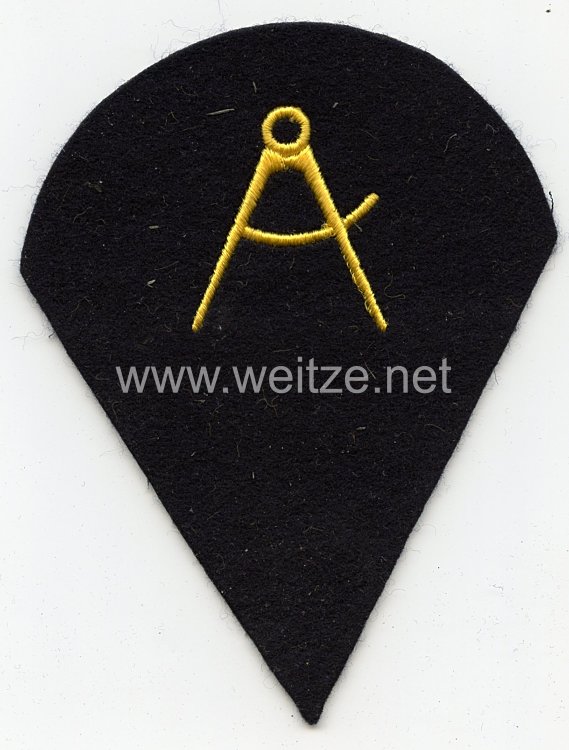
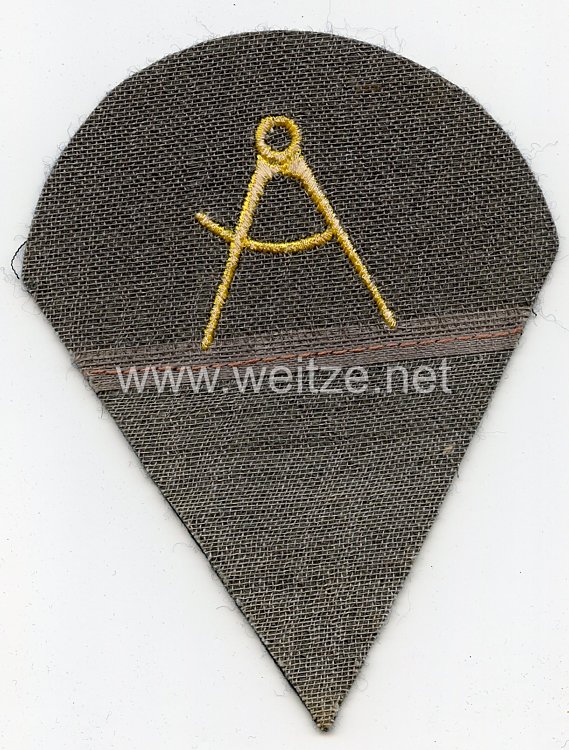
Kriegsmarine Enlisted Men's Career Sleeve Insignia Carpenter
The Kriegsmarine Sleeve Badge for Enlisted Ranks in the Carpenter Career Track represents a fascinating aspect of German naval uniform regulations during World War II. These specialized badges served to identify various craft and technical occupational groups within the Kriegsmarine and were an integral component of the complex rank insignia system of the German Navy between 1935 and 1945.
The Kriegsmarine, officially established on June 1, 1935, replaced the Reichsmarine of the Weimar Republic. With the reintroduction of universal conscription and open rearmament under the National Socialist regime, an extensive system for identifying ranks, career tracks, and special qualifications was developed. Career track badges for enlisted personnel were worn on the left upper arm and enabled immediate identification of a sailor's professional specialization.
The Zimmermann (ship's carpenter) belonged to the traditional craft professions of the navy, whose roots extend back to the era of wooden sailing ships. Although steel vessels dominated in the 20th century, carpenters remained indispensable aboard ship. They were responsible for all woodwork on board, including maintenance and repair of deck planking, interior fittings, furniture, boats, and other wooden structures. On larger vessels, carpenters also worked with other craftsmen to repair damage and ensure the seaworthiness of the ship.
The badge itself typically displayed the characteristic symbols of the carpenter's trade: crossed carpenter's axe and broadaxe or similar tools, often framed by a laurel wreath or other decorative elements. The execution was usually as an embroidered badge on dark, navy-blue base fabric that matched the standard uniform of enlisted ranks. The embroidery was mostly executed in yellow or gold thread, which corresponded to the traditional color scheme of the Kriegsmarine.
The mention of execution for the Kollani refers to a special variant of the badge. The term "Kollani" or more correctly "Kolani" designates a special navy-blue work suit worn by enlisted ranks during certain duties. This working uniform differed from the parade uniform and was designed for practical shipboard service. Badges for this uniform variant could differ slightly in their execution from those of the walking-out uniform, but were designed according to the same regulations.
The dress regulations of the Kriegsmarine were detailed in the "Anzugsbuch für die Kriegsmarine" (Dress Manual for the Navy, M.Dv. Nr. 130). This set of rules specified precisely which badges could be worn when, where, and how. Career track badges for enlisted ranks were an important component of these uniform regulations and were subject to strict design guidelines. The correct placement on the left upper arm at a specific height was prescribed to ensure a uniform appearance across all units of the navy.
Historically considered, the carpenter's badge reflects the importance that the Kriegsmarine attached to traditional craft professions. Despite the increasing technologization and mechanization of warfare at sea, craft skills remained indispensable. Carpenters were particularly in demand when damage occurred from combat, collisions, or in emergency situations when quick repairs could determine the survival of the crew.
The production of such badges was carried out by various manufacturers and suppliers who contracted with the Kriegsmarine. Quality could vary depending on the time of manufacture and producer. Early war years often showed higher-quality hand embroidery, while later in the war, especially from 1943/44 onwards, increasingly simplified or machine-made versions were used as resources became scarcer.
From a collector-historical perspective, these career track badges are today significant testimonies of naval history. They document not only the organizational structure of the Kriegsmarine, but also the appreciation of specialized occupational groups within the military hierarchy. The presence of foxing, as mentioned with this specimen, is typical for textile militaria that have been stored for decades under less than optimal conditions. Such signs of aging do not diminish the historical value but often confirm the authenticity of a piece.
The study of these seemingly small details of military history contributes to a more comprehensive understanding of everyday life in the armed forces and shows that beyond the great battles and strategic decisions, there existed a complex system of roles, responsibilities, and traditions that enabled the operation of a modern navy.