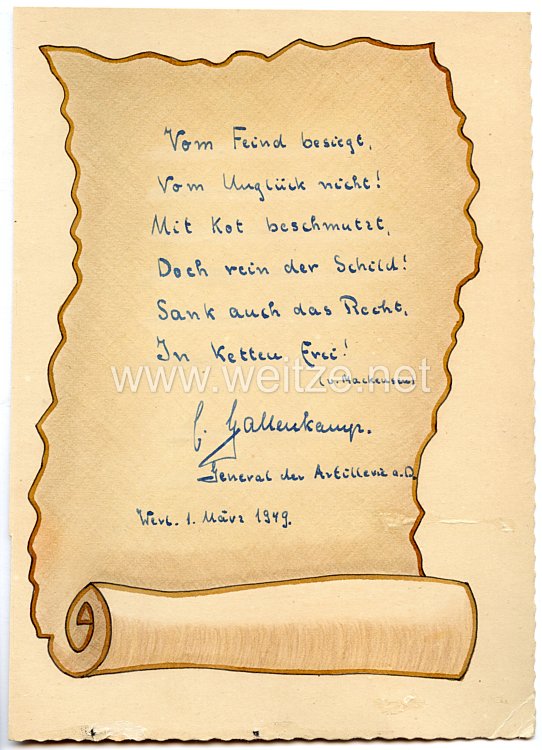
Army - Post-War Signature of Knight's Cross Recipient General der Artillerie Curt Gallenkamp

on a cardboard-backed A4 page from a guest book of the Werl prisoner of war camp where many high-ranking officers were interned. The page is handwritten and signed “C.Gallenkamp. General der Artillerie a.D. Werl 1. März 1949”.

http://www.jva-werl.nrw.de/behoerde/historie/index.php
309402
100,00

Army - Post-War Signature of Knight's Cross Recipient General der Artillerie Curt Gallenkamp

The signature of General der Artillerie Curt Gallenkamp on a page from a guestbook at the Werl prisoner-of-war camp represents a remarkable contemporary historical document from the immediate post-war period. Dated March 1, 1949, this signature documents a moment in the history of the Allied internment of high-ranking German Wehrmacht officers after the end of World War II.

Curt Gallenkamp was born on April 4, 1890, in Kassel and pursued a classic military career in the German Empire and later in the Reichswehr and Wehrmacht. He joined the Prussian Army as an officer cadet in 1909 and served as an artillery officer during World War I. During the interwar period, he continued his military career in the Reichswehr and developed into an experienced troop commander and artillery expert.

During World War II, Gallenkamp commanded various artillery units and corps. He was awarded the Knight's Cross of the Iron Cross on August 21, 1944, one of the highest military decorations of the German Reich. He received this honor for his leadership achievements on the Eastern Front, where he served as a commanding general.

The Werl internment camp in North Rhine-Westphalia played a special role in post-war history. From 1945, the British occupation forces used the local prison as a prisoner-of-war camp and internment facility for high-ranking German officers, generals, and other individuals who were being examined as part of the denazification process. The facility was designated as Civil Internment Camp No. 6 and housed numerous holders of the highest military decorations as well as generals from various branches of service.

The practice of keeping guestbooks in such camps was not uncommon. These books served various purposes: they documented the presence of internees, enabled a certain cultural exchange within the prisoner community, and sometimes represented a form of self-assurance and identity preservation for the internees. Many high-ranking officers used such opportunities to record their military ranks and positions, often with the addition “a.D.” (außer Dienst, meaning retired), symbolizing the formal conclusion of their military careers.

The year 1949, when this signature was created, was a turning point in German post-war history. On May 23, 1949, the Basic Law was promulgated and the Federal Republic of Germany was founded. The Allied powers gradually began to relax their internment policies, and many of the imprisoned officers were released in the following years. The signature from March 1, 1949, thus falls within a transitional phase in which the immediate post-war order was slowly giving way to a new political reality.

Autographs and signatures of Knight's Cross recipients and high-ranking Wehrmacht officers from the post-war period are today sought-after military-historical documents. They offer insights into the personal fates of these men after the unconditional surrender and document an often-overlooked aspect of German post-war history. Internment camps like Werl were places of reflection, uncertainty about the future, and transition from a military to a civilian existence.

For historical research, such documents are significant because they illuminate the living conditions and psychological situation of the internees. The fact that Gallenkamp continued to use his rank “General der Artillerie a.D.” shows the need of many officers to maintain their military identity despite the changed circumstances.

The history of the Werl correctional facility dates back to the 19th century. The complex, built between 1906 and 1912, originally served as a penitentiary and became a significant site of contemporary history through its use as an internment camp after 1945. Today it again houses a regular correctional facility, but the historical significance of the location remains preserved.

Personal documents such as this signature remind us of a complex era of transition and reorientation in German history and contribute to understanding the individual experiences that lay behind the major political developments of the post-war period.