World War I Aviation - Photo Postcard - German Flying Aces "Hauptmann Buddecke"
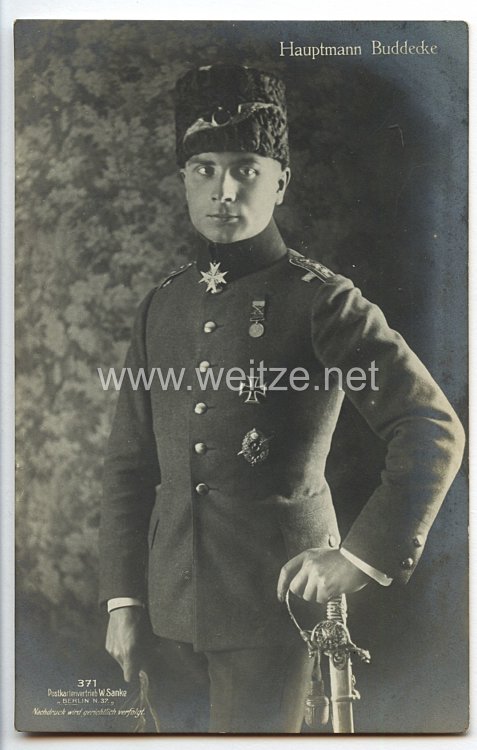
This Sanke postcard No. 371 features Hauptmann Hans-Joachim Buddecke, one of the most renowned German fighter pilots of World War I. This card belongs to the famous series of photographs published by the Berlin publisher Gustav Liersch & Co. under the name Sanke, which are among the most sought-after collectibles in military history.
The Sanke cards formed an extensive series of photographic postcards produced during World War I between 1914 and 1918. The publisher specialized in portraits of German military heroes, particularly aviators, submarine commanders, and highly decorated soldiers. These cards served both as war propaganda and as objects of hero worship on the home front. They were printed in large editions and were equally popular among soldiers and civilians. The numbering of the cards reached over 800 different motifs, with the aviator cards being among the most popular.
Hauptmann Hans-Joachim Buddecke was born on May 7, 1890, in Berlin and developed into one of the most extraordinary fighter pilots of the Imperial German Air Service. His military career began in 1911 when he joined the army. After the outbreak of World War I, he was initially deployed as an infantry officer but soon transferred to the aviation corps. Buddecke earned his reputation not only on the Western Front but especially through his service in more exotic theaters of war.
Particularly remarkable was Buddecke's deployment in the Ottoman Empire, where he was one of the few German pilots to fight on the Turkish front. From 1915 to 1916, he flew missions over Mesopotamia, Palestine, and the Arabian Peninsula. There he achieved several of his total 13 confirmed aerial victories. His achievements in the Orient earned him not only German decorations but also the Turkish Iron Crescent and the Gallipoli Star. This combination of German and Ottoman honors made him a unique figure among German aviators.
Buddecke was awarded the Pour le Mérite on April 10, 1916, the highest Prussian military order, colloquially known as the “Blue Max.” He was thus one of the first fighter pilots to receive this prestigious decoration. After his return from the Orient, he was deployed on the Western Front, where he continued his career as a fighter pilot.
The photograph on the Sanke card typically shows Buddecke in his aviator's uniform, possibly with his decorations. The quality of these photographs was remarkably high for the time. The photographers of the Sanke series usually worked in professional studios and used the best available equipment. The portraits were carefully staged to present the heroes of the Reich in the best light. The cards often bore on the reverse the notation “Photochemie Berlin” or similar printer's marks.
The condition 2 of this card indicates very good preservation, according to the standard collector's scale from 1 (perfect) to 5 (poor). The fact that the card is unmailed means it was never used postally, which significantly increases its collector value. Unmailed cards are considerably rarer today than those that were actually sent, as many copies were mailed to family members and friends during the war.
The historical significance of such postcards lies in several aspects. First, they document the propaganda strategy of the German Empire, which wanted to present the new air forces as a modern, technologically advanced branch of service. The aviators were stylized as “knights of the air,” a deliberate connection to chivalric tradition that romanticized the brutal reality of industrialized warfare. Second, they are valuable biographical sources for researching individual personalities like Buddecke. Third, they reflect the visual culture and means of communication of the wartime period.
Hauptmann Buddecke did not survive the war for long. On March 10, 1918, he died in an aircraft crash near Jametz in France. The exact circumstances of his death remain partially unclear – it is not definitively established whether he was shot down in aerial combat or whether a technical defect caused the crash. He was only 27 years old.
Today, Sanke cards are sought-after collectibles that achieve different values depending on the rarity of the pilot depicted, condition, and whether they are mailed or unmailed. Cards of Pour le Mérite recipients like Buddecke are among the more valuable examples of the series. They are preserved in militaria collections worldwide and are important objects for researching the history of aerial warfare and the military commemorative culture of World War I.