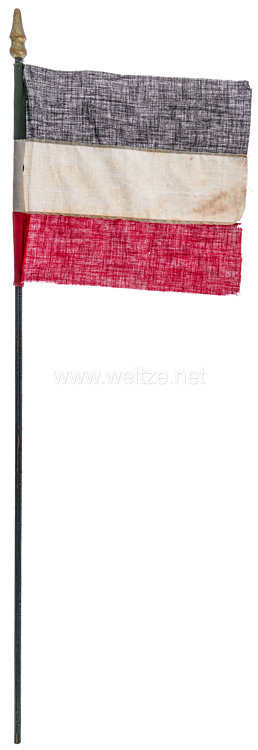
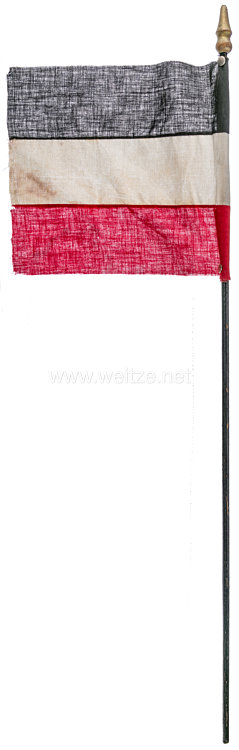
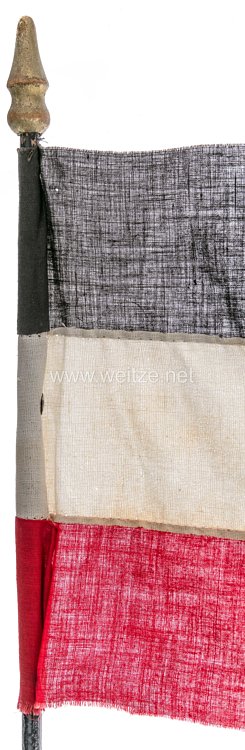
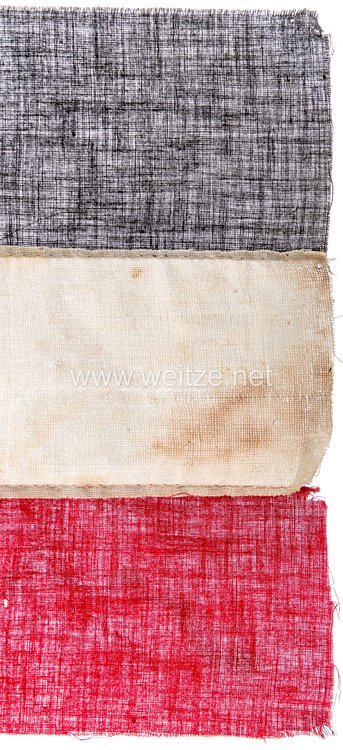
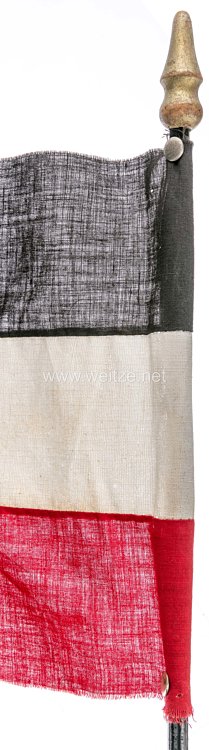
German Reich - Patriotic Flag

Dimensions: approx. 22 x 24 cm, on wooden stick. Condition 2.
313702
80,00

German Reich - Patriotic Flag

The present patriotic flag of the German Reich, measuring approximately 22 x 24 cm and mounted on a wooden stick, represents a fascinating aspect of German military and everyday history. Such small flags, often referred to as hand flags or stick flags, played a significant role in the visual and symbolic culture of the German Reich from its founding in 1871 until its end in 1945.

The German Reich underwent several political epochs during its existence, each employing different flags and patriotic symbols. The Imperial period (1871-1918) was characterized by the black-white-red Reich colors, which derived from the combination of Prussian colors (black-white) and Hanseatic colors (white-red). This color combination was officially established as the Reich colors by decision of the Reichstag on November 14, 1892, symbolizing the unity of Germany united under Prussian leadership.

Patriotic flags of this type were produced in large quantities and served various purposes. They were ubiquitous at military parades, victory celebrations, imperial birthdays, and other national festivities. Particularly during World War I (1914-1918), such patriotic memorabilia experienced an enormous surge. The population used them to demonstrate support for the war effort, and they were frequently waved at soldiers' farewells, war bond campaigns, and victory celebrations.

After World War I and the proclamation of the Weimar Republic in 1919, the official Reich colors changed to black-red-gold, the colors of the democratic movement of 1848. Nevertheless, the black-white-red colors retained their significance in conservative and monarchist circles. Various veterans' associations, nationalist organizations, and later the NSDAP drew upon this symbolism.

The production of such hand flags was carried out by numerous manufacturers throughout the Reich. They were made from various materials, typically printed or dyed cotton fabric or silk, attached to simple wooden sticks. Quality varied considerably, from simple, mass-produced specimens for everyday use to high-quality, elaborately designed flags for official occasions. The compact size of approximately 22 x 24 cm was ideal for personal use and made these flags popular items among the civilian population.

The significance of such patriotic symbols cannot be underestimated. In an era when mass media were still in their infancy, visual symbols like flags served as important means of national identity formation and political mobilization. They were visible signs of belonging to a community and expressed loyalty to the Kaiser, the Reich, or later to other political systems.

During the Nazi period (1933-1945), patriotic flags and symbols were employed even more systematically. The regime used mass events where thousands of such flags were waved to create an image of unity and support. The production of patriotic memorabilia was state-directed and controlled.

Today, such historical flags are sought-after collectibles that represent important testimonies of German history. They document not only the political systems of their time but also everyday culture, production techniques, and the ways in which people expressed their national identity. The condition grade 2 indicates a well-preserved specimen, which is quite remarkable for textiles from this era, as many were lost through use, storage conditions, or deliberate destruction after 1945.

For historians and collectors, such objects offer valuable insights into the material culture of past epochs. They remind us that history consists not only of great events and significant personalities but also of the everyday objects that surrounded people and reflected their worldview.

r