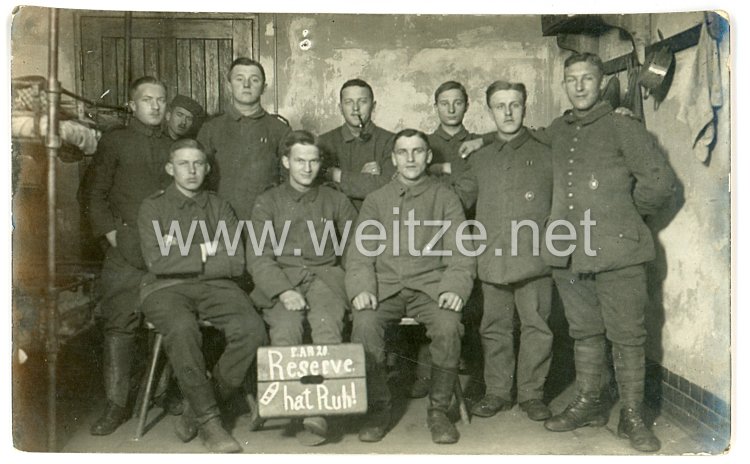
German Army Group Photograph, Soldiers from Feldartillerie-Regiment 20

postcard size, used condition.
332202
8,00

German Army Group Photograph, Soldiers from Feldartillerie-Regiment 20

This postcard depicts a group photograph of soldiers from Field Artillery Regiment 20, a significant unit of the German Imperial Army (Deutsches Heer). Such photographic documents from the Imperial era and World War I are important testimonies of military history, offering insights into the life and organization of the armed forces of that period.

Feldartillerie-Regiment 20 (Field Artillery Regiment 20) was originally established as part of the Prussian Army and was garrisoned in Karlsruhe in Baden. Field artillery formed the backbone of the German artillery arm and was responsible for mobile fire support for infantry on the battlefield. Unlike heavy artillery or fortress artillery, field artillery regiments were designed to keep pace with infantry divisions and quickly take up positions.

The structure of a field artillery regiment in the Imperial era typically comprised two battalions (Abteilungen), each with three batteries. Each battery was usually equipped with six guns, mostly field guns of 7.7 cm or later 7.5 cm caliber. The personnel strength of a full regiment was approximately 1,000 to 1,200 men, plus several hundred horses that were essential for transporting the guns and ammunition.

Photographic postcards like this one were extremely popular between approximately 1890 and 1918. They served various purposes: soldiers had themselves photographed in uniform to send these images to family and friends. At the same time, they expressed regimental pride and comradeship. The postcard format made mailing simple and inexpensive. Commercial photographers established themselves in garrison towns and offered their services specifically for military personnel.

The uniforms of field artillerymen differed in details from the infantry. Artillerymen traditionally wore black uniform tunics with red facings and piping, the branch color of the artillery. In group photos like this, various ranks can often be identified, from simple gunners through non-commissioned officers to commissioned officers. Headgear consisted of the characteristic Pickelhaube (spiked helmet) or later the more practical field cap.

During World War I, Field Artillery Regiment 20 played an important role on various fronts. German field artillery was technically advanced at the outbreak of war in 1914 and was considered efficiently organized. The training of artillerymen was demanding and included ballistic knowledge, target acquisition, ammunition handling, and cooperation with infantry. The development of trench warfare from late 1914 fundamentally changed the role of field artillery. From a mobile weapon, it increasingly became a static instrument of material warfare.

The photographic documentation of military units has a long tradition. Since the invention of photography in the mid-19th century, soldiers and their regiments were photographed. These images served not only personal but also propagandistic and documentary functions. They show uniforms, equipment, weaponry, and provide information about the social composition of units.

For military historical research, such photographs are of invaluable worth. They complement written sources such as regimental histories, war diaries, and official documents. Through analysis of uniform details, badges, and equipment items, precise dating can often be determined. The posture, facial expressions, and arrangement of soldiers also provide clues about military hierarchies and camaraderie structures.

After World War I and the Treaty of Versailles in 1919, the German Army was drastically reduced. Traditional regiments were dissolved and replaced by the small Reichswehr, limited to 100,000 men. However, the old regimental traditions continued in veterans' associations, and photographs like this became important mementos of a bygone era.

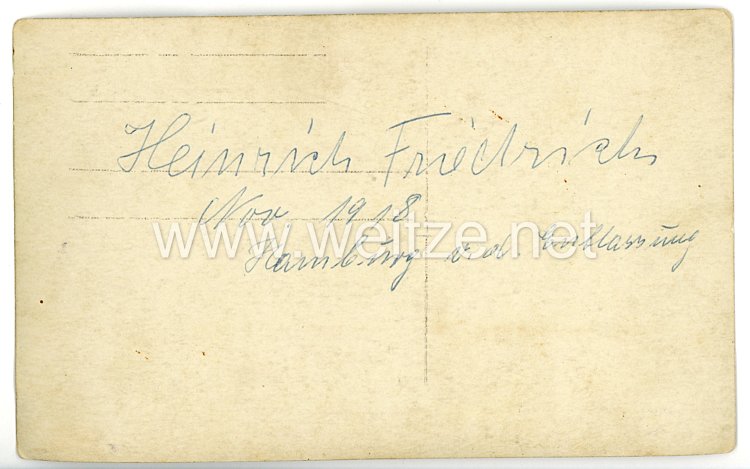
Today, such military historical photographs are preserved by collectors, museums, and archives. They document not only military history but also social and cultural history. The fact that this postcard has survived in used condition suggests that it was actually mailed and thus fulfilled its original function as a means of communication. Postmarks, handwritten notes, or address information can provide additional historical information.

r