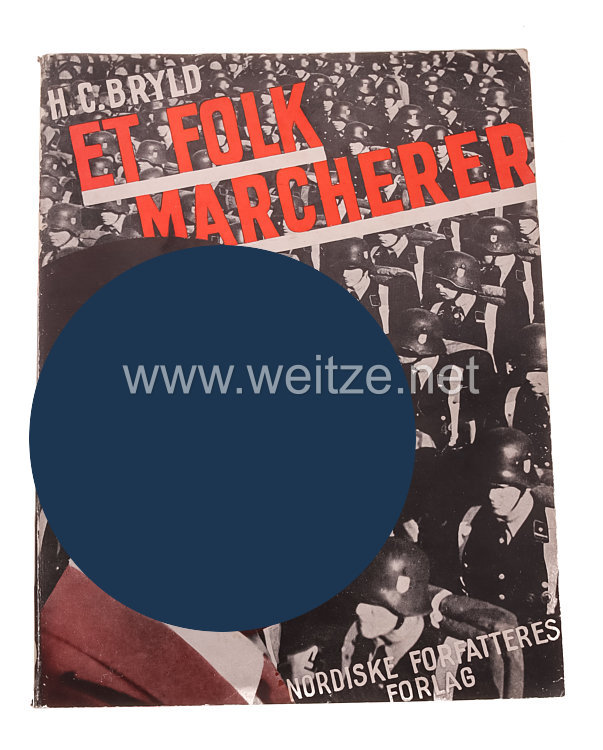
Denmark in World War II: NS Pictorial Volume "Et Folk marcherer" by H.C. Bryld

NS propaganda pictorial volume, published by "Nordiske Forfatteres Forlag Kobenhavn 1941". 177 pages, with numerous photographs of the German NS leadership from 1923 to 1941.
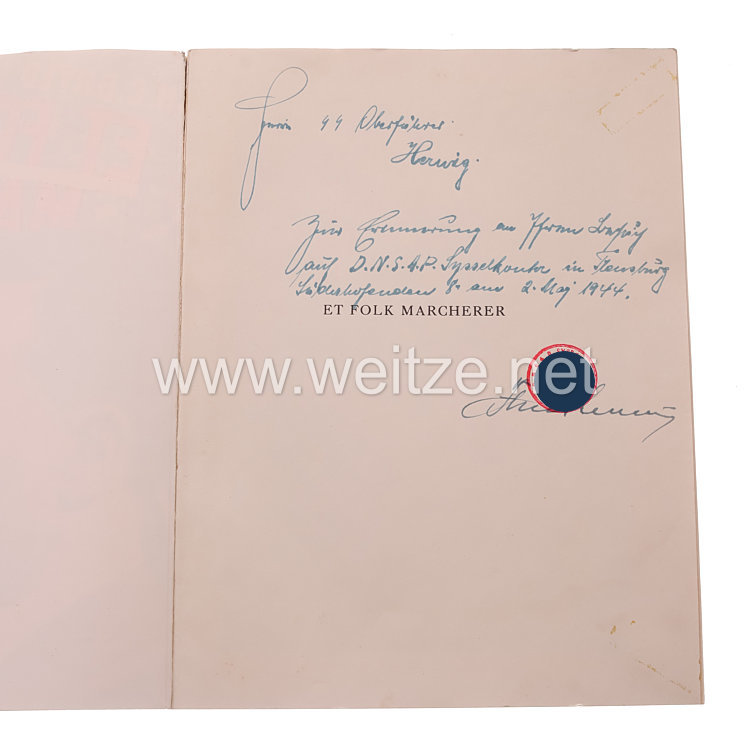
This is a presentation copy with a handwritten dedication from the D.N.S.A.P. Flensborg to SS-Standartenführer Karl Herwig,- NSDAP mayor of the cities of Wesselburen and Heide (Holstein), commander of the 53. SS-Standarte. Condition 2.


444102
350,00

Denmark in World War II: NS Pictorial Volume "Et Folk marcherer" by H.C. Bryld

Historical Context: Nazi Propaganda in Denmark During World War II

The illustrated volume “Et Folk marcherer” (A People Marches) by H.C. Bryld, published in 1941 by Nordiske Forfatteres Forlag in Copenhagen, represents a significant testimony to National Socialist propaganda activities in Denmark during the German occupation. The work documents the visual staging of the Nazi leadership from 1923 to 1941 and was part of comprehensive efforts to spread Nazi ideology in the occupied Scandinavian countries.

The German Occupation of Denmark

On April 9, 1940, Operation Weserübung began, during which German forces occupied Denmark and Norway. Denmark capitulated the same day after minimal resistance. Unlike other occupied territories, Denmark initially received special status: the Danish government remained in office, and the country was treated as a “model protectorate.” This relatively mild occupation policy was intended to present Denmark as an example of “peaceful cooperation” between Germanic peoples and was part of Nazi racial ideology that classified Scandinavians as “Aryan.”

The D.N.S.A.P. and Nazi Collaboration

The Danmarks Nationalsocialistiske Arbejderparti (D.N.S.A.P.), founded in 1930, was Denmark's National Socialist party. Under the leadership of Frits Clausen, it attempted to gain ground following the German model but remained a fringe movement throughout the pre-war period with minimal voter support. Even in the 1939 elections, the D.N.S.A.P. received only about 1.8 percent of the vote.

After the German occupation in 1940, the party gained significance as a collaboration organization, although it never found broad support among the Danish population. The D.N.S.A.P. established local organizations, including in Flensborg (Flensburg), a historically German-Danish border city. The dedication in this copy from D.N.S.A.P. Flensborg illustrates the networking between German Nazi functionaries and Danish collaborators.

SS-Standartenführer Karl Herwig

The recipient of this gift, Karl Herwig, was a significant figure in the Nazi hierarchy of Schleswig-Holstein. As an SS-Standartenführer (a rank equivalent to colonel), he commanded the 53rd SS-Standarte, a unit belonging to the Allgemeine SS. The Allgemeine SS was the original Schutzstaffel organization and differed from the military Waffen-SS units.

Herwig simultaneously served as NSDAP mayor in Wesselburen and Heide in Holstein, demonstrating the typical combination of party, SS, and administrative functions in the Nazi state. This accumulation of offices was characteristic of the Nazi system, in which loyal party members held both civilian and paramilitary positions.

Propaganda Publications in Occupied Scandinavia

The illustrated volume “Et Folk marcherer” belongs to an extensive propaganda campaign directed at the Scandinavian countries. The Reich Ministry of Public Enlightenment and Propaganda under Joseph Goebbels coordinated the production and distribution of such materials. Specially prepared publications were created for Scandinavia that emphasized the alleged cultural and racial affinity between Germany and the Nordic peoples.

Photographic volumes were a preferred medium of Nazi propaganda. They presented the Nazi leadership and its stagings in carefully curated images that suggested strength, order, and historical greatness. The time span from 1923 to 1941 encompasses the entire development of the NSDAP from the failed Hitler Putsch to the early war successes.

The Role of Gift Copies

Dedicated gift copies like this one played an important role in the Nazi patronage system. They served to cultivate relationships between various Nazi organizations and demonstrated mutual recognition. The presentation from the D.N.S.A.P. to a German SS leader symbolizes the desired solidarity between German and Danish National Socialists.

Historical Significance

Objects like this illustrated volume are today important sources for researching Nazi propaganda, collaboration in occupied territories, and networking between Nazi organizations. They document the mechanisms by which the Nazi regime attempted to spread its ideology beyond Germany's borders and win local supporters. At the same time, they show the limited effect of these efforts: despite intensive propaganda, support for the D.N.S.A.P. in Denmark remained marginal, and Danish resistance grew continuously until liberation in 1945.

r