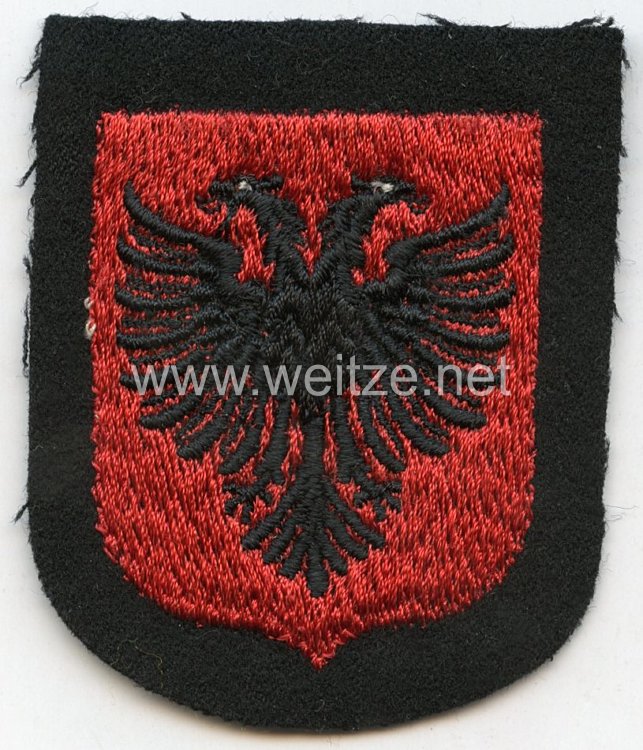
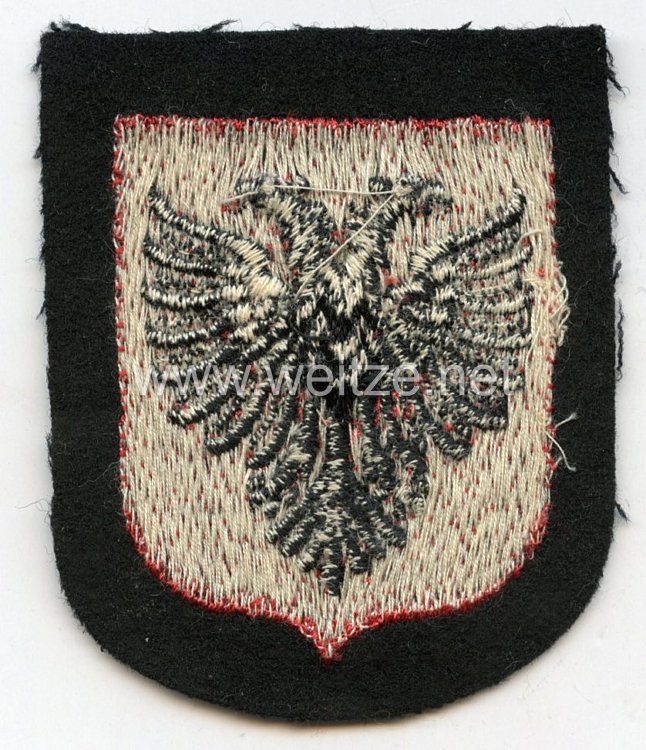
Sleeve Shield of the Albanian Volunteers of the Waffen-SS Div. “Skanderbeg”

RZM-embroidered version. Unissued condition, Condition 2.
437502
265,00

Sleeve Shield of the Albanian Volunteers of the Waffen-SS Div. “Skanderbeg”

The arm shield of the 21st Waffen Mountain Division of the SS “Skanderbeg” represents a significant, albeit controversial, testament to the complex history of the Waffen-SS during World War II. This division, composed predominantly of Albanian volunteers, was established in 1944 and named after the Albanian national hero Gjergj Kastrioti Skanderbeg (1405-1468), who fought against the Ottoman Empire in the 15th century.

The division was founded in April 1944 at the instigation of Reichsführer-SS Heinrich Himmler, who sought to recruit soldiers for the Waffen-SS from various occupied territories of Europe. The formation took place primarily in Kosovo and northern Albania, regions that were under German occupation at the time. The division was intended primarily for anti-partisan operations in this area.

The arm shield itself typically displays the Albanian coat of arms featuring the double-headed eagle and the characteristic goat-head helmet of Skanderbeg. This symbolism was meant to appeal to the national pride of Albanian recruits and establish a connection to Albania's glorious past. The RZM-embroidered execution indicates official production. RZM stands for Reichszeugmeisterei, the central procurement office of the NSDAP, responsible for quality control and licensing of party and SS equipment.

The technical execution of such arm shields followed strict regulations. They were manufactured on a mostly black or field-gray background and worn on the left upper arm of the uniform. The RZM marking guaranteed that the piece was manufactured according to official standards, which was of great importance given the multitude of divisional insignia of the Waffen-SS.

The 21st Waffen Mountain Division of the SS “Skanderbeg” had a short and turbulent existence. It never reached its full authorized strength and suffered from considerable organizational problems. The division consisted mainly of Kosovo Albanians and had a strength of approximately 6,000 to 8,000 men, far below normal divisional strength. German officers and non-commissioned officers formed the command structure.

The unit was deployed primarily for security duties and anti-partisan operations in Kosovo and southern Serbia. This resulted in numerous war crimes against the Serbian civilian population. The division was also involved in the persecution and deportation of the Jewish population of Kosovo, a dark chapter in its history.

In autumn 1944, as the military situation deteriorated for Germany and the Red Army advanced in the Balkans, the division began to disintegrate. Many Albanian soldiers deserted when it became clear that Germany would lose the war. In November 1944, the division was officially dissolved, with the remaining German members being transferred to other units.

From a collector's perspective, arm shields of the “Skanderbeg” division are relatively rare. The division's short existence, its limited size, and the chaotic circumstances of its dissolution meant that only a limited number of these insignia were produced and issued. Unworn specimens in good condition are particularly rare, as most pieces produced were actually used.

The historical assessment of this division and its symbols remains controversial. While some Albanian nationalists view the unit as part of the struggle for Albanian interests, academic research overwhelmingly classifies it as part of the criminal SS apparatus. The division was involved in serious war crimes and ultimately served the objectives of the National Socialist regime.

For military historians and collectors, such an arm shield represents an important object of study regarding the history of the Waffen-SS and its recruitment policy in Southeastern Europe. It documents the desperate attempts of the Third Reich in the late phase of the war to mobilize troops from occupied territories by instrumentalizing national and religious sentiments.

r