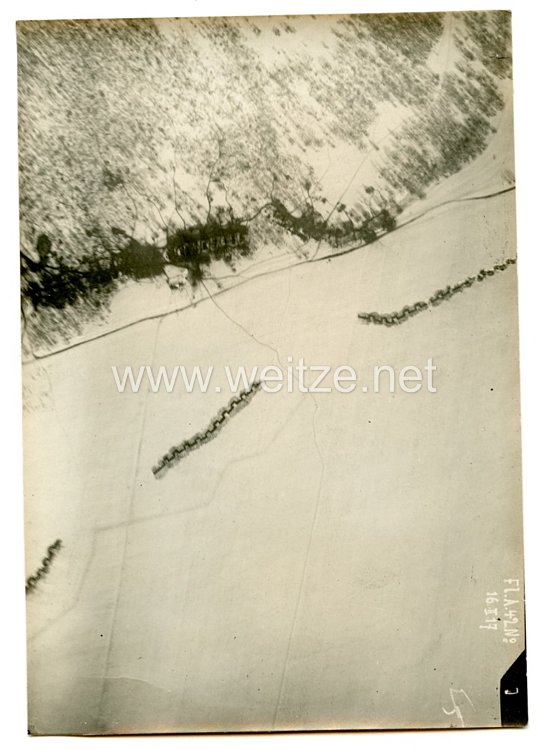
World War I German Army Photograph, Aerial View of the Western Front
Aerial Photographs from the Western Front in World War I
This photograph represents an aerial reconnaissance image from the Western Front of World War I and documents one of the most significant technological advances in military intelligence and warfare. With dimensions of approximately 17 x 12 cm, this image corresponds to the typical format for military reconnaissance photographs of that era.
The Development of Aerial Photography in World War I
When World War I broke out in August 1914, military aviation was still in its infancy. The first aircraft of the German Army were mainly used for reconnaissance purposes. Already in the first months of the war, the German military leadership recognized the enormous potential of aerial photography for strategic and tactical warfare. The Flying Corps of the German Army, officially founded in 1913, rapidly developed into an indispensable instrument of warfare.
Initially, observers were equipped with commercial cameras, but specialized aerial cameras soon emerged. Companies such as Zeiss, Görz, and Ernemann developed cameras specifically designed for the requirements of aerial photography. These devices had to be robust enough to withstand vibrations and extreme temperatures at high altitudes.
Technical Aspects and Procedures
Aerial photographs were typically taken from altitudes between 1,000 and 4,000 meters. Photographers had to work with heavy cameras in open or semi-open cockpits, often under enemy fire. Sequential cameras enabled systematic photography of front sections, which were later assembled into detailed maps.
The development and analysis of photographs took place in special photographic interpretation units behind the front lines. Trained officers and technicians analyzed the images for changes in enemy positions, new trenches, artillery positions, ammunition depots, and troop movements. This information was invaluable for planning attacks and coordinating artillery fire.
The Western Front and Its Documentation
The Western Front, which stretched from the North Sea coast to the Swiss border, was the scene of the bloodiest battles of World War I between 1914 and 1918. The complex system of trenches, bunkers, barbed wire obstacles, and artillery positions extended for hundreds of kilometers. Aerial photographs were the only means of gaining an overview of this vast battlefield.
Famous battles such as the Battle of Verdun (1916), the Battle of the Somme (1916), or the Battle of Flanders (1917) were comprehensively documented from the air. These photographs show the moonscape created by intense artillery bombardment, as well as the complex defensive installations of both sides.
Military and Historical Value
Aerial photographs like the present one had several purposes. First, they served immediate military reconnaissance. Copies were distributed to command posts where they were used for operational planning. After analysis, many photographs were archived and served as historical documentation.
Some photographs were also used for propaganda purposes or distributed to soldiers as mementos. It was not uncommon for flight crews to keep prints of their photographs as souvenirs or give them to comrades.
Preservation and Collector Value
Original aerial photographs from World War I are important historical documents today. They offer not only military-historical insights but also document the landscape and topography of France and Belgium before their destruction. Many of the villages and towns visible in these photographs were completely destroyed during the war.
The state of preservation of such photographs varies greatly. The condition grade “2” indicates good to very good preservation, which is remarkable for photographs over one hundred years old. Factors such as storage, light exposure, and humidity affect the durability of these historical documents.
Conclusion
Aerial photographs from the Western Front of World War I are more than just military artifacts. They represent a turning point in the history of warfare and mark the beginning of modern military reconnaissance. These photographs offer us today a unique view of one of the most devastating conflicts in human history and remind us of the technological developments that shaped this war.