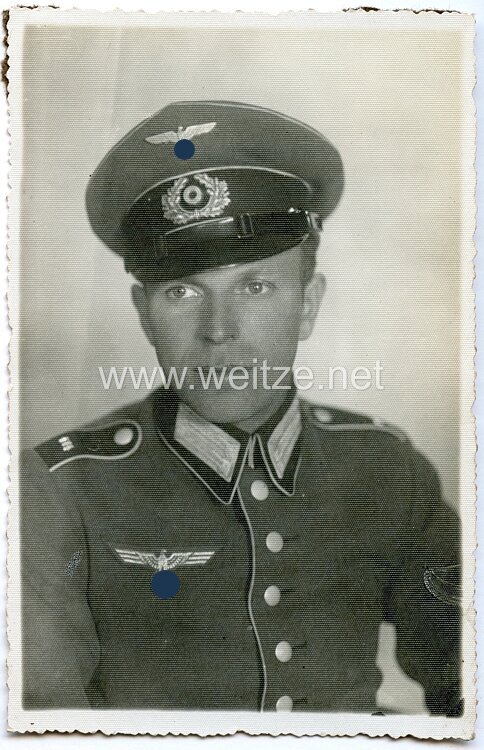
Wehrmacht Portrait Photograph, Member of an Infantry Regiment
The portrait photograph of a member of a Wehrmacht Infantry Regiment represents a widespread form of military commemorative culture during World War II. Such photographs in postcard format were an essential component of communication between soldiers and their families, as well as an important personal memento of military service.
The Wehrmacht, which existed from 1935 to 1945 as the unified armed forces of National Socialist Germany, comprised the Army (Heer), Navy (Kriegsmarine), and Air Force (Luftwaffe). The infantry formed the backbone of the Army and was organized into numerous infantry regiments. Throughout the war, several million soldiers served in these units, deployed on all fronts from Western Europe to North Africa and the Eastern Front.
Portrait photographs in postcard format (typically 9 x 14 cm or 10.5 x 14.8 cm) were extremely popular in Germany during the 1930s and 1940s. Soldiers often had their photographs taken shortly after induction or before deployment to the front. These images were usually produced in professional photo studios, frequently located near barracks and garrisons. Photographers were thoroughly familiar with military uniform regulations and staged soldiers according to the conventions of the time.
The uniforming of Wehrmacht infantry followed strict regulations defined in the Army Service Regulation (Heeresdienstvorschrift, HDv) and the Dress Regulations (Anzugordnungen). Infantry soldiers typically wore the field-gray uniform with characteristic rank insignia, shoulder boards, and collar patches. The branch color (Waffenfarbe) of the infantry was white, visible on collar tabs and shoulder boards. Regimental designations and numbers on the shoulder boards allowed identification of the respective unit.
The photographic practice during the Wehrmacht era was highly standardized. Portrait shots usually showed the soldier in a semi-frontal or slightly turned position, often looking directly at the camera or slightly to the side. Lighting was professionally designed to make the uniform and insignia clearly visible. Many studios used neutral backgrounds, while others worked with patriotic or military backdrops.
These photographs fulfilled several important social and personal functions. For the soldiers themselves, they were a means of self-representation at a time when military service was highly regarded socially. Families received through these images a visual connection to their relatives at the front. The postcard format size made it easy to send the photos, include them in letters, or keep them in albums and frames.
The significance as historical sources of such photographs is multifaceted today. They document the uniforms, equipment, and rank structures of the Wehrmacht. At the same time, they offer insights into the visual culture and self-representation of the military in the Third Reich. For military historians and uniform specialists, these photographs are valuable study objects, as they show details often not recorded in official documents.
The preservation and collection of such military-historical photographs also raises ethical questions. While they are undoubtedly historical documents of scientific value, they simultaneously represent members of an organization involved in war crimes and genocide. Serious collectors and museums therefore treat these objects within the context of a critical examination of Nazi history.
The indicated Condition 2 corresponds in collector nomenclature to very good preservation with possibly minor signs of use. Photographs from this period may exhibit various signs of aging, from slight discoloration to creases or edge damage, depending on their storage over eight decades.
In summary, a Wehrmacht infantry portrait photograph represents a contemporary historical document that reflects both the military organization and the everyday and commemorative culture of the period between 1935 and 1945. Today it serves as a source for military-historical research while also calling for critical engagement with this dark chapter of German history.