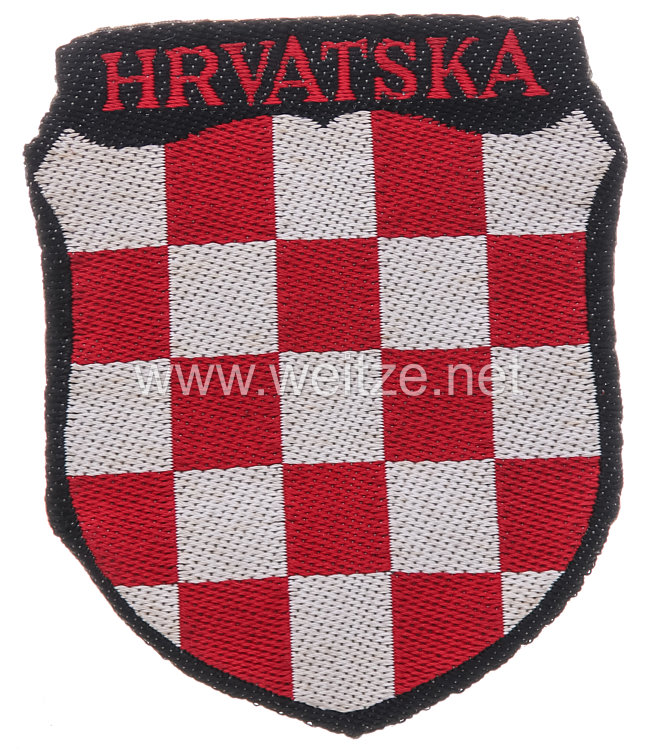
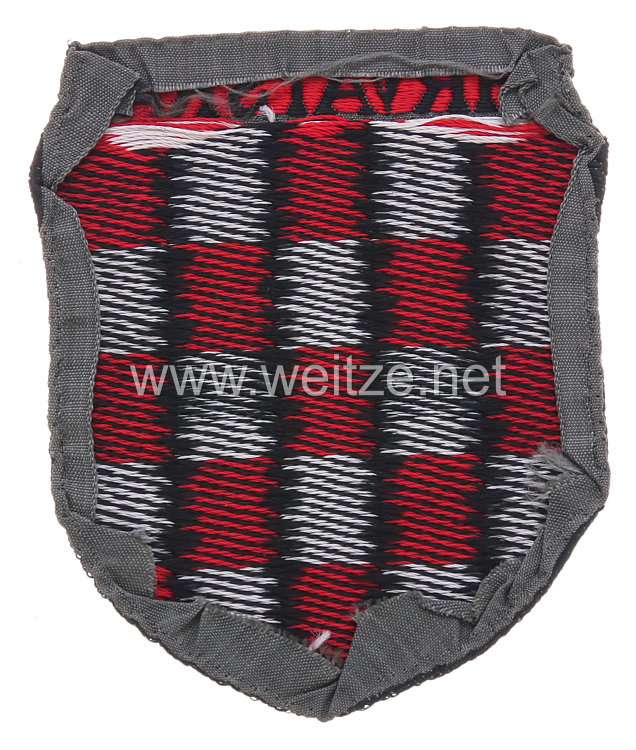
Wehrmacht Heer Sleeve Shield of the Croatian Volunteers in the Wehrmacht

BeVo woven version with inscription “Hrvatska”. Worn condition, Condition 2+.

389001
350,00

Wehrmacht Heer Sleeve Shield of the Croatian Volunteers in the Wehrmacht

The Croatian Volunteer Sleeve Shield in the Wehrmacht represents a significant example of the insignia awarded to foreign volunteer units within the German armed forces during World War II. This particular badge was worn by Croatian volunteers who served in various units of the Wehrmacht.

Following the dismemberment of Yugoslavia in April 1941, the Independent State of Croatia (Nezavisna Država Hrvatska) was established under the leadership of Ante Pavelić and his fascist Ustasha movement as a satellite state of the German Reich. Within this political context, numerous Croatian citizens began volunteering for service in the German Wehrmacht.

Croatian volunteers were deployed in various formations, the most famous being the 369th (Croatian) Infantry Division, also known as the “Devil's Division” or “Vražja divizija”. This division was established in August 1942 and fought primarily on the Eastern Front. Additionally, Croatian volunteers served in other Wehrmacht units as well as in the Waffen-SS, particularly in the 13th Waffen Mountain Division of the SS “Handschar”.

The sleeve shield bearing the inscription “Hrvatska” (Croatia) was worn on the right upper arm of the uniform and served as a national identification. This practice followed an established system within the Wehrmacht whereby foreign volunteer units wore national sleeve badges to identify their origin. Similar badges existed for volunteers from other nations such as the Netherlands, Belgium, France, and the Baltic states.

The Bevo-woven execution refers to a special manufacturing technique developed by the company BeVo (Bandfabrik Ewald Vorsteher) from Wuppertal. This technique enabled the machine production of highly detailed textile badges with woven patterns and lettering. Bevo badges were widespread during World War II and were used for various military purposes, from sleeve insignia to cap emblems.

The introduction of these sleeve badges occurred within the framework of the Heeresverordnungsblätter (Army Regulation Sheets) and other military regulations that governed the uniform and insignia regulations of the Wehrmacht. The national badges were intended to preserve the identity of volunteer units while symbolizing their integration into the German military structure.

The deployment of Croatian volunteers in the Wehrmacht was part of a comprehensive National Socialist strategy aimed at mobilizing military resources from allied and occupied territories. These volunteers were recruited both for ideological reasons (anti-communism, Croatian nationalism) and pragmatic considerations (economic necessity, thirst for adventure).

The 369th Infantry Division experienced intense combat operations on the Eastern Front, particularly during the battles for Stalingrad in winter 1942/43, where it suffered heavy losses. After the retreat from the Don, the division was reconstituted in 1943 and continued its battles on various front sectors. Later it was transferred to the Balkans in 1944, where it was deployed against partisan forces.

The wearers of these sleeve badges were thus part of a complex historical situation where national identity, political collaboration, and military necessity converged. After the war, many of these volunteers faced severe consequences as they were regarded as traitors by communist Yugoslavia under Josip Broz Tito.

Today, such sleeve shields are important historical artifacts that provide insight into the complex history of military collaboration during World War II. They document the participation of various national groups in the war effort and the organizational structure of the Wehrmacht. Collectors and historians value these objects as material witnesses to a dark period of European history.