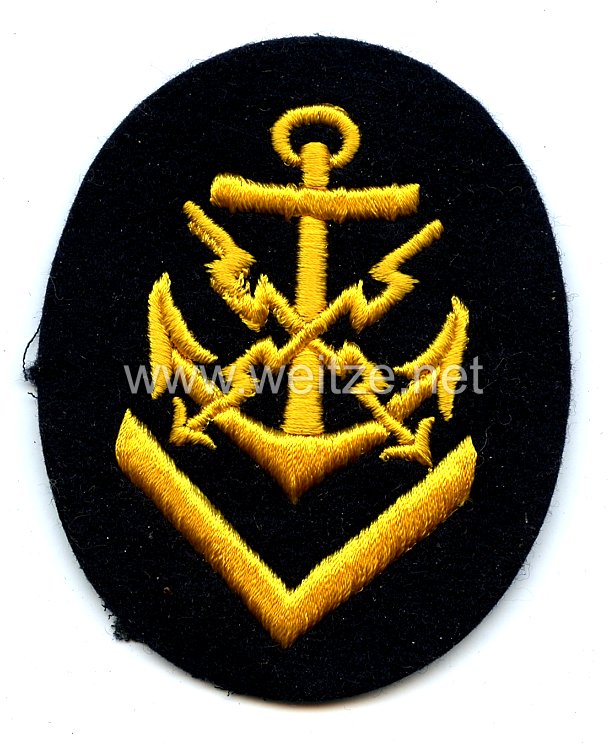
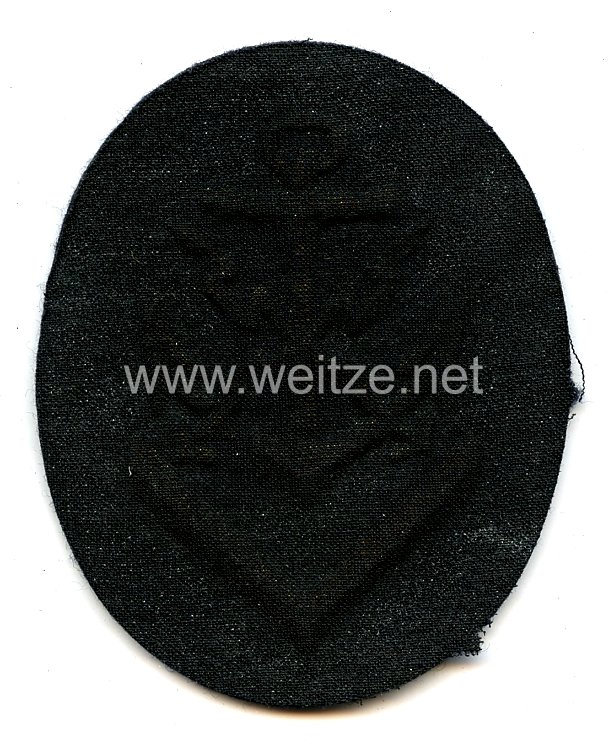
Kriegsmarine Sleeve Insignia Career Path Senior Teletype Petty Officer

for the blue blouse. Condition 2+.
375401
25,00

Kriegsmarine Sleeve Insignia Career Path Senior Teletype Petty Officer

The Kriegsmarine sleeve badge for Oberfernschreibmaat represents a specialized technical rank within the German Kriegsmarine during World War II. This badge was worn on the blue service uniform and identified a petty officer who served in the teletype communications field – an essential area for military communications.

The Kriegsmarine, as one of the three branches of the Wehrmacht, was officially founded in 1935, replacing the Reichsmarine of the Weimar Republic. With the development of a modern naval force came a complex system of ranks and career badges that clearly displayed various specializations and ranks.

The rank of Oberfernschreibmaat belonged to the career group of senior petty officers (Portepee-Unteroffiziere), who stood between the ordinary seamen and commissioned officers. The term “Maat” traditionally designated a petty officer rank in the German Navy, while the prefix “Ober-” indicated a higher position within this rank level. Teletype operators were responsible for transmitting encrypted and unencrypted messages via teletype machines – a task of the highest strategic importance.

The sleeve badges of the Kriegsmarine followed a strictly regulated system defined in dress regulations and uniform directives. These career badges were worn above the rank stripes on both sleeves and displayed specific symbols indicating the respective specialty. For teletype personnel, this typically consisted of a stylized symbol reflecting the technical nature of their duties.

The blue service uniform on which this badge was worn was part of the Kriegsmarine's shipboard uniform. It was worn during daily duty aboard warships, in naval bases, and during certain shore assignments. The dark blue color was characteristic of the German Navy and distinctly different from the field gray uniforms of the Army or the blue-gray of the Luftwaffe.

The manufacture of such sleeve badges was carried out by authorized producers who had to meet the Navy's strict quality requirements. The badges were typically machine-embroidered, using various thread weights and colors to render the required details. The base usually consisted of a navy blue cloth piece precisely matched to the uniform.

The signals branch of the Kriegsmarine played a crucial role in naval warfare. The coordination of fleet units, transmission of orders, weather reporting, and not least encrypted communication – all depended on reliable signal connections. Teletype operators worked both ashore in communication centers and aboard larger warships, where dedicated radio rooms and signals departments were established.

Training to become a Fernschreibmaat was comprehensive and required both technical understanding and absolute reliability. The men had to master not only the operation of teletype equipment but also understand the basics of encryption and work precisely under often difficult conditions at sea. Promotion to Oberfernschreibmaat required several years of service and proven competence.

The present badge in condition 2+ indicates a well-preserved original that shows only minor signs of wear. This suggests that it was either worn only briefly or carefully stored. Such badges are today important study objects for military historians and collectors specializing in Kriegsmarine uniform studies.

In the context of naval history, these sleeve badges document not only military hierarchy but also the increasing mechanization of naval warfare in the 20th century. The specialization in teletype technology reflects the growing importance of electronic communication, which would revolutionize all military and civilian communications in subsequent decades.

The preservation of such insignia provides valuable insights into the organizational structure and technical sophistication of the German Navy during this period. Each badge tells a story of specialized training, military tradition, and the evolution of naval communications technology during a pivotal era in maritime history.

r