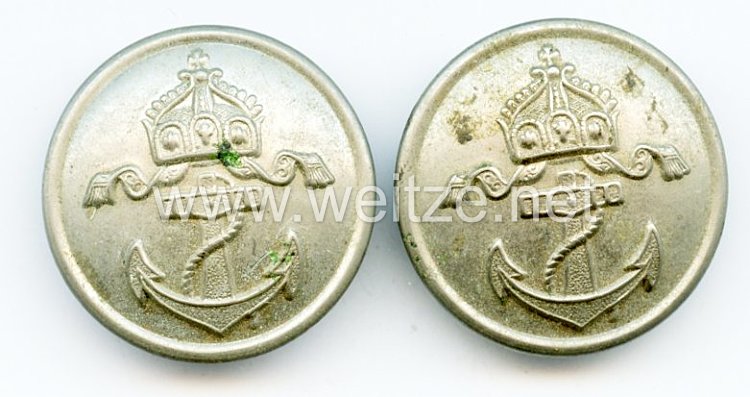
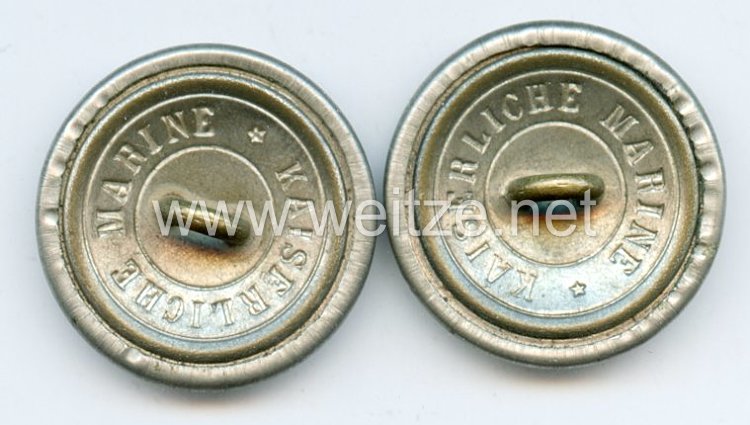
Imperial German Navy Pair of Large Buttons

Silver-plated execution, circa 1910, 26 mm, for the kolani tunic, identical maker, lightly worn, condition 2-.
437501
40,00

Imperial German Navy Pair of Large Buttons

The Imperial German Navy (Kaiserliche Marine) of the German Empire represented one of the most significant maritime forces between 1871 and 1918. The buttons described here provide an authentic example of uniform equipment from this era and offer insight into the detailed regulation of military dress in Wilhelmine Germany.

These silver-plated buttons with a diameter of 26mm were manufactured around 1910 and were intended for the Kollani (Kolani or Koller), a special uniform jacket of the Imperial Navy. The 26mm size classifies these as large buttons, typically attached to prominent positions on the uniform, as opposed to smaller buttons used for pockets or sleeve slits.

Historical Context of the Imperial Navy

The Imperial Navy underwent massive expansion under Kaiser Wilhelm II from 1888 onwards. The Kaiser, who possessed a particular affinity for seafaring, initiated an extensive naval construction program. Under the leadership of Grand Admiral Alfred von Tirpitz, appointed Secretary of State of the Imperial Naval Office in 1897, the navy developed into a world power. The Naval Laws of 1898 and 1900 marked the beginning of an unprecedented armament program.

During this period of rapid expansion and modernization, uniforming was a central element of military identity. The precise design of uniforms, including buttons, was subject to strict regulations and served to represent imperial power.

Uniform Buttons and Their Significance

Military buttons were far more than functional elements; they were carriers of symbolism and status markers. The buttons of the Imperial Navy typically displayed the national emblem with anchor and crown, often surrounded by an oak leaf wreath. The silver-plated execution indicates higher quality, possibly intended for officers or special uniform pieces.

Production was carried out by specialized manufacturers who worked according to precise military specifications. The fact that both buttons came from identical manufacturers was customary and ensured uniformity. Manufacturers often had to mark their products with company signs, which today facilitates authentication and dating.

The Kollani

The term Kollani (or Koller) refers to a traditional uniform jacket worn in various variants by the Navy. This jacket was part of the parade uniform and was distinguished by its elaborate design. The large buttons were prominently attached to the front closure and contributed significantly to the representative appearance.

Dating and Historical Context around 1910

The year 1910 falls within a phase of intense maritime rivalry, particularly with the British Empire. The Anglo-German naval race shaped international politics during these years. The Navy expanded continuously, and the number of sailors and officers increased substantially, creating corresponding demand for uniform equipment.

During this period, uniform regulations were also repeatedly revised and refined. The dress regulations of the Imperial Navy minutely regulated the material, size, attachment, and quality of all uniform parts, including buttons.

Condition and Collector Value

The description as “lightly worn” with condition 2- (on a scale where 1 means mint condition) indicates authentic traces of use that document historical wear. Such traces are often more valuable to collectors than unused pieces, as they document actual use.

Silver-plated buttons could show signs of wear at heavily stressed points over time, with the underlying metal becoming visible. This is not unusual for originals from this era and does not significantly affect historical value.

Significance for Military History

Such uniform items are important sources for military and everyday history. They document manufacturing techniques, material usage, and aesthetic concepts of their time. For research on the Imperial Navy, they provide insights into uniforming practices and the material culture of the military in the Empire.

The Imperial Navy was severely reduced after World War I by the provisions of the Treaty of Versailles in 1919 and transformed into the Reichsmarine of the Weimar Republic. Uniform parts from the imperial period were partly reused, partly melted down or dissolved, making original pieces sought-after collector's items today.

These buttons represent a tangible connection to the ambitious naval policy of the German Empire and the daily life of its sailors and officers. They embody the technical craftsmanship, military precision, and imperial prestige that characterized the Kaiserliche Marine during its zenith before the catastrophe of World War I fundamentally changed the European order.