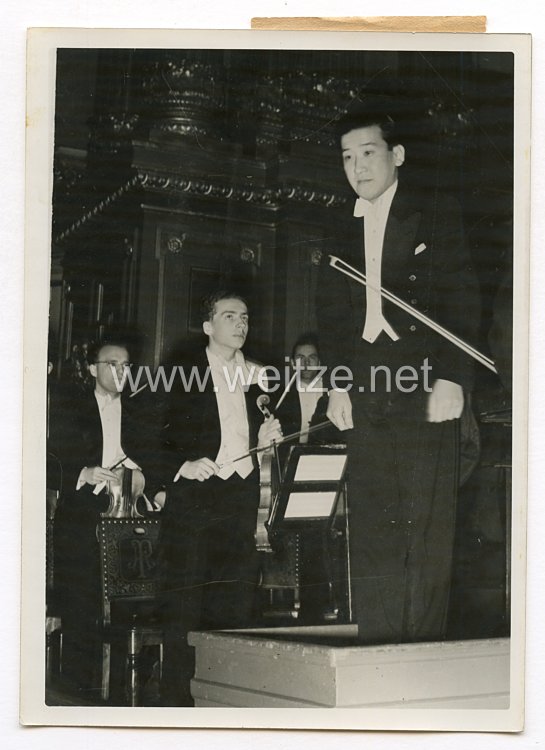
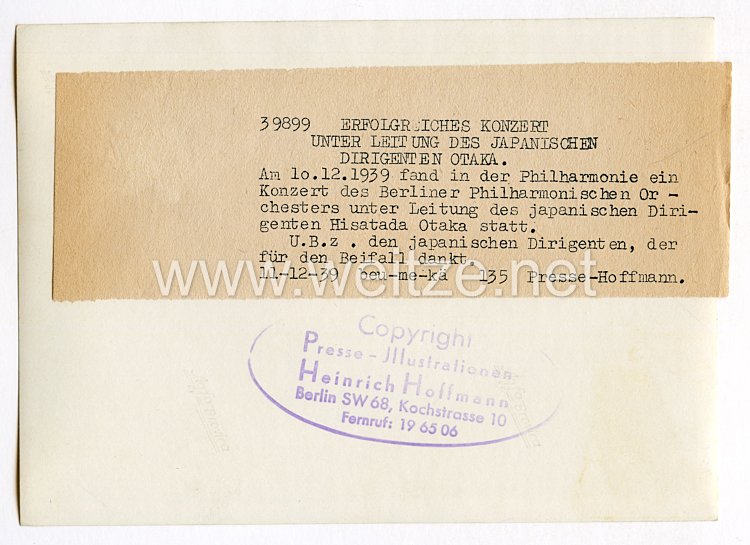
Third Reich Press Photo. Successful Concert Conducted by Japanese Conductor Otaka. December 10, 1939.

Dimensions: approx. 13 x 18 cm, with description on reverse, Heinrich Hoffmann, used condition.
320701
15,00

Third Reich Press Photo. Successful Concert Conducted by Japanese Conductor Otaka. December 10, 1939.

Press Photography in the Third Reich: Cultural Propaganda and German-Japanese Relations

This press photograph from the Heinrich Hoffmann publishing house documents a concert conducted by the Japanese conductor Otaka on December 10, 1939, representing a remarkable testament to National Socialist cultural propaganda and German-Japanese relations in the early phase of World War II.

Heinrich Hoffmann and Nazi Press Photography

Heinrich Hoffmann (1885-1957) was Adolf Hitler's personal photographer and operated one of the most influential photographic services of the Third Reich. His publishing house, Hoffmann & Co., held a de facto monopoly on official photographs of the Nazi leadership and produced millions of press photos for the coordinated press. The photographs typically bore stamps, descriptions, and often censorship numbers from the Reich Ministry for Public Enlightenment and Propaganda under Joseph Goebbels on their reverse sides.

These press photographs in the 13 x 18 cm format were the standard size for distribution to newspapers and magazines. They served the visual control and steering of public opinion and were a central instrument of National Socialist media policy.

The Historical Context: December 1939

December 1939 marks a specific phase of World War II. The German invasion of Poland in September 1939 had led to the entry of Great Britain and France into the war. The Soviet Union had occupied eastern Poland in accordance with the Hitler-Stalin Pact and was conducting the Winter War against Finland. Germany was in the phase of the “Phoney War” on the Western Front.

During this period, the Nazi regime intensified its cultural policy activities domestically to strengthen the “home front” and demonstrate normalcy. Concerts, theater performances, and other cultural events continued and were exploited for propaganda purposes.

German-Japanese Relations and the Anti-Comintern Pact

The presence of a Japanese conductor in Germany and its media emphasis must be understood in the context of German-Japanese relations. The Anti-Comintern Pact of 1936, to which Japan and Germany belonged as founding members, formed the basis for the later Berlin-Rome-Tokyo Axis. Italy joined in 1937, and in 1940 the pact was expanded into the Tripartite Pact.

Nazi propaganda emphasized the commonalities between Germany and Japan, with racist ideologies being pragmatically reinterpreted. Despite Nazi racial ideology, Japanese were treated as “honorary Aryans.” Cultural exchange, including musical performances, served to demonstrate this “Axis friendship.”

Japanese Musicians in Nazi Germany

Several Japanese conductors and musicians were active in Germany during the 1930s. The most famous was Hidemaro Konoye, who led the New Symphony Orchestra Tokyo to Europe in 1937. The conductor Otaka mentioned here could have been Hisatada Otaka (1911-1951), a Japanese composer and conductor who studied in Germany and was active in Europe in the late 1930s.

These cultural encounters were exploited for propaganda purposes by both sides. For Japan, recognition by European cultural institutions meant a gain in prestige; for Germany, the presence of Japanese artists demonstrated international acceptance of the regime and the strength of the Axis powers.

Music and Propaganda in the Nazi State

Music played a central role in National Socialist cultural policy. The Reich Music Chamber, a subsidiary organization of the Reich Chamber of Culture, controlled all musical life. Concerts were carefully monitored and instrumentalized for propaganda. Reporting on cultural events followed strict guidelines from the Propaganda Ministry.

Press photographs of concerts served multiple purposes: they were meant to demonstrate normalcy and cultural superiority, strengthen the “Volksgemeinschaft” (people's community), and in the case of international artists, visualize the regime's foreign policy relations.

Collector Value and Historical Significance

Press photographs from the Heinrich Hoffmann publishing house are important historical sources today. They document not only the depicted events but also the mechanisms of Nazi propaganda. The reverse inscriptions, stamps, and censorship notes provide additional information about the production and distribution channels of these images.

For collectors and historians, such photographs are of interest because they provide insight into the everyday propaganda of the Third Reich, beyond spectacular mass events. A photograph of a Japanese conductor from December 1939 documents the complex international relations in the early phase of World War II and the role of culture in National Socialist foreign policy.

The described object is an authentic testimony to a time when culture, politics, and propaganda were inextricably intertwined, and when even a seemingly apolitical concert event was part of a comprehensive system of opinion control and ideological influence.

r