Third Reich Police: Large Jingling Johnny (Schellenbaum) of the Music Corps of the Schutzpolizei Hamburg Altona-Wandsbek

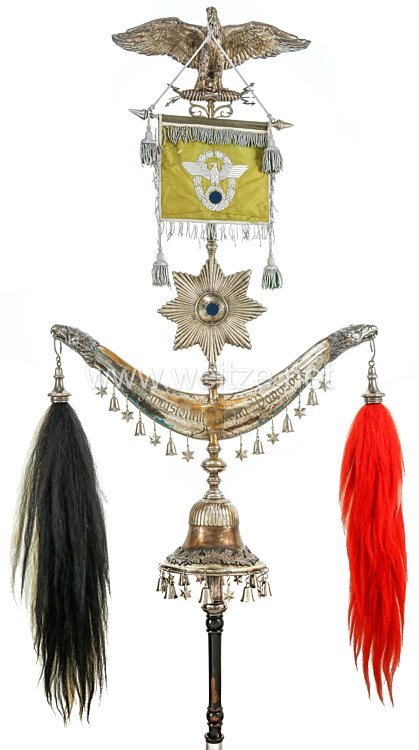
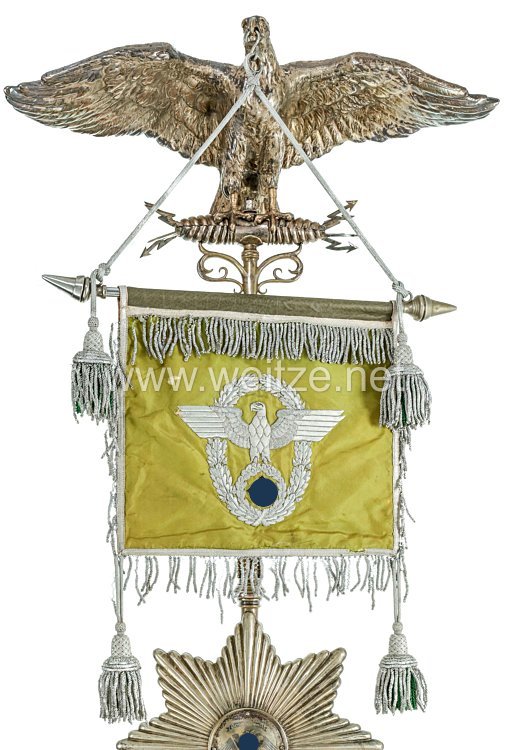
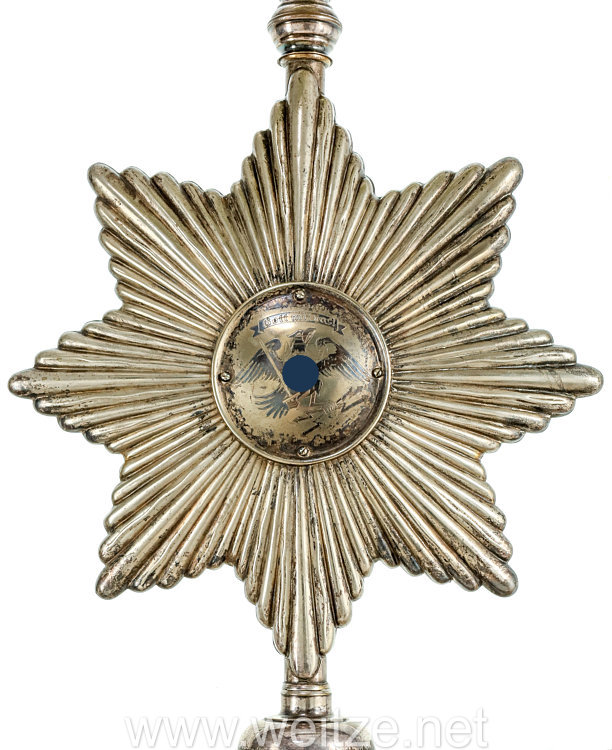
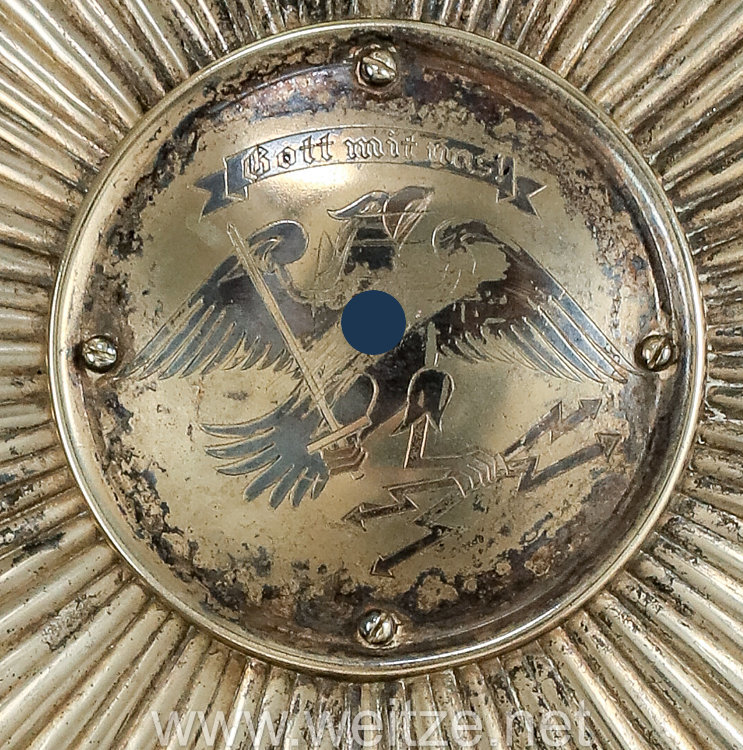
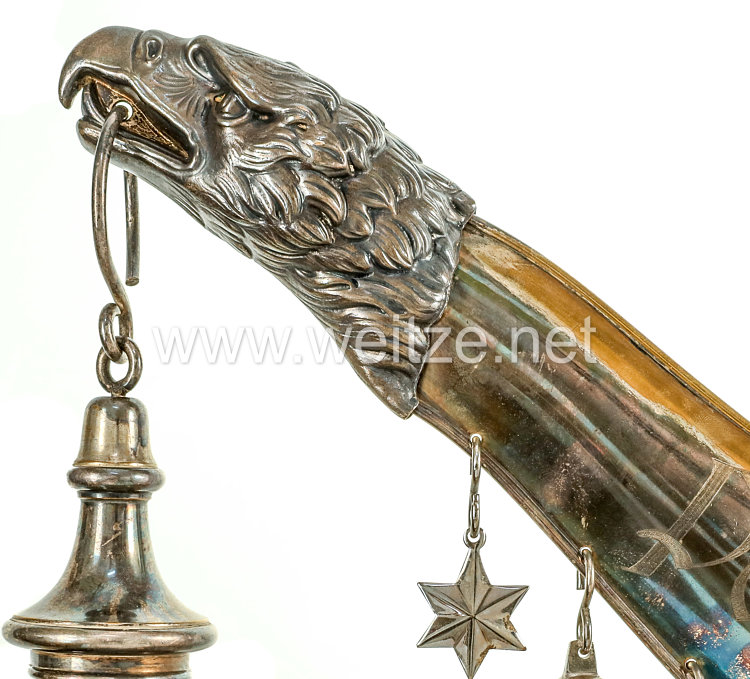
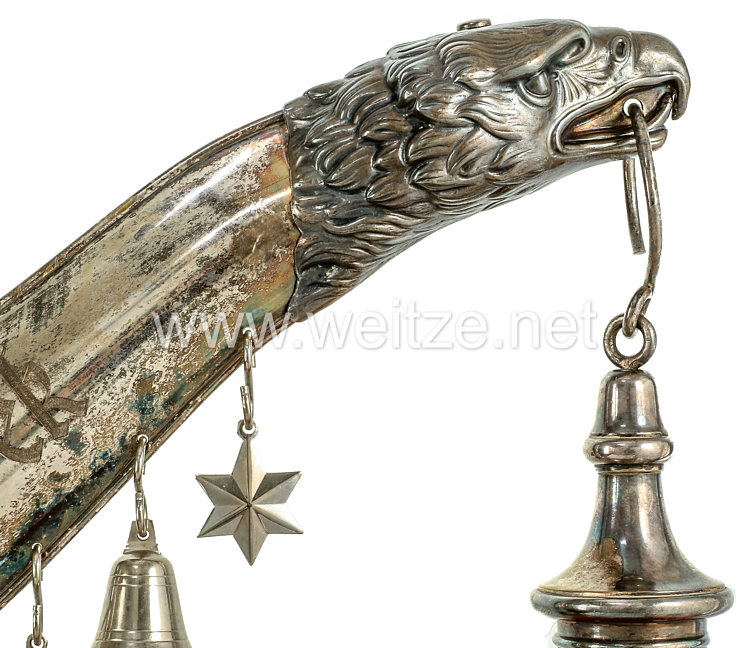
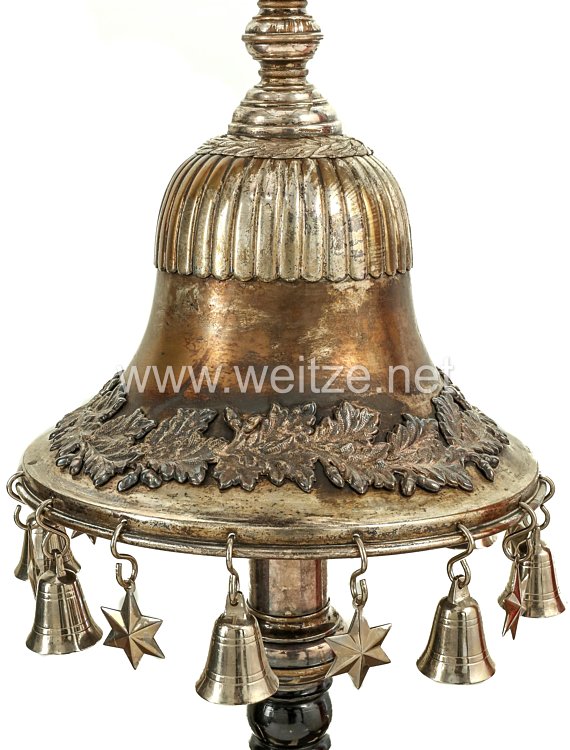
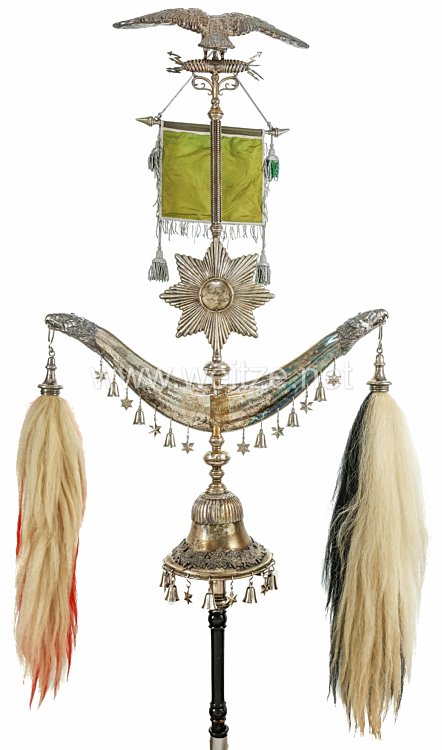
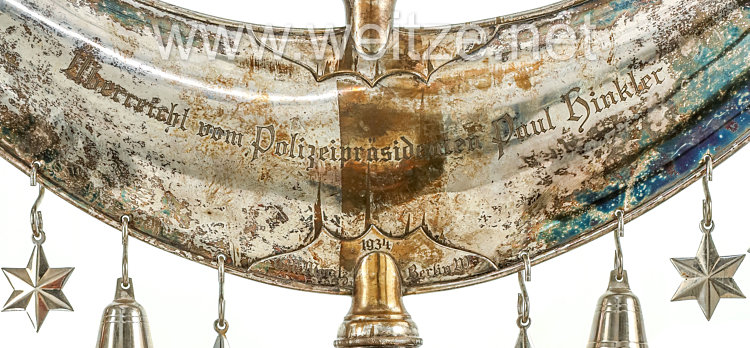
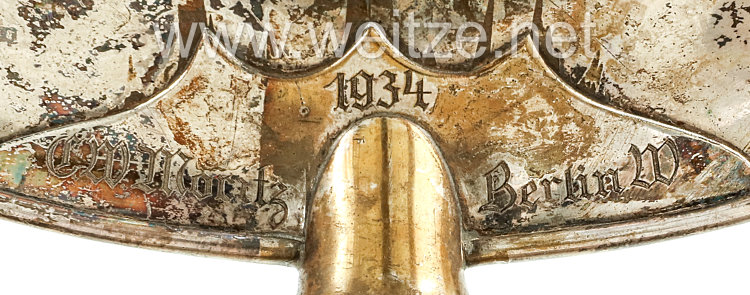
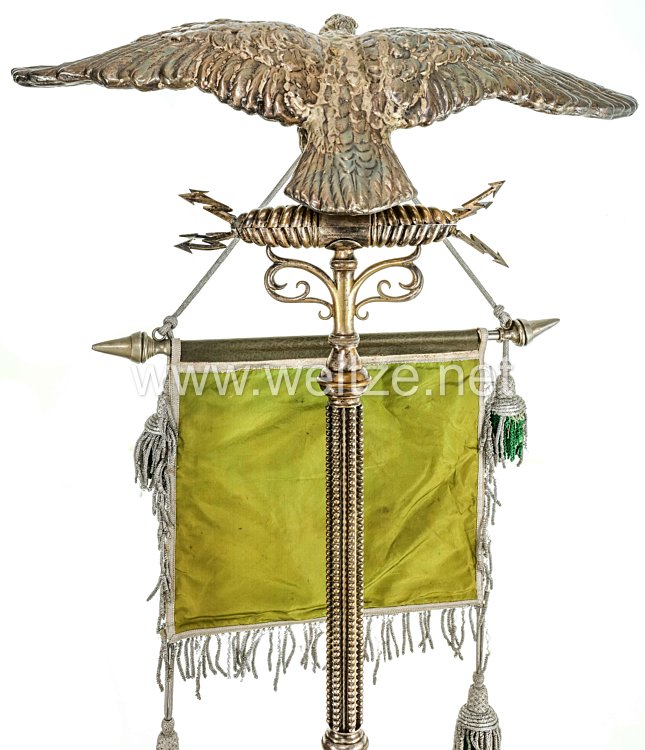
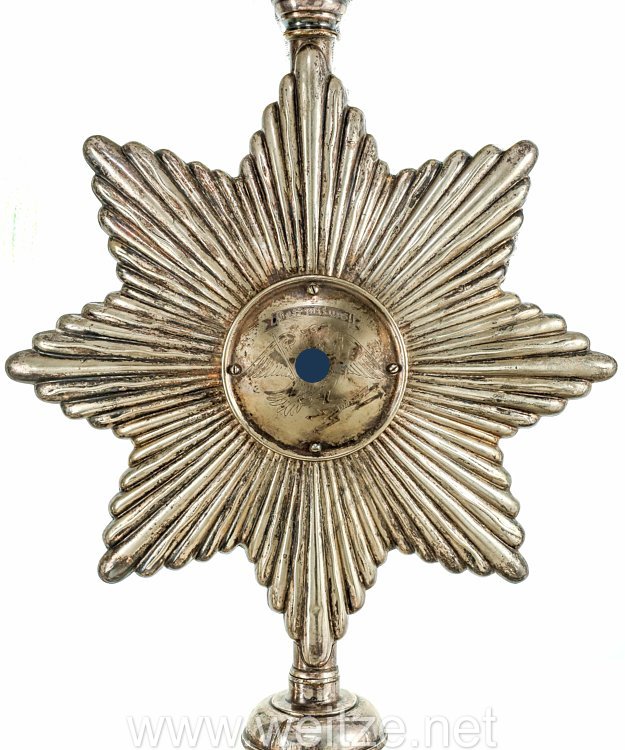
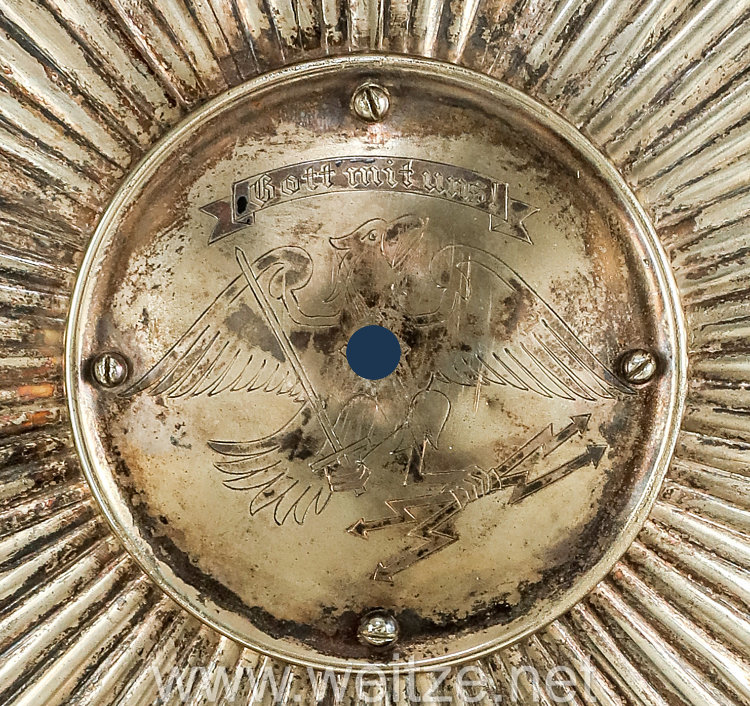
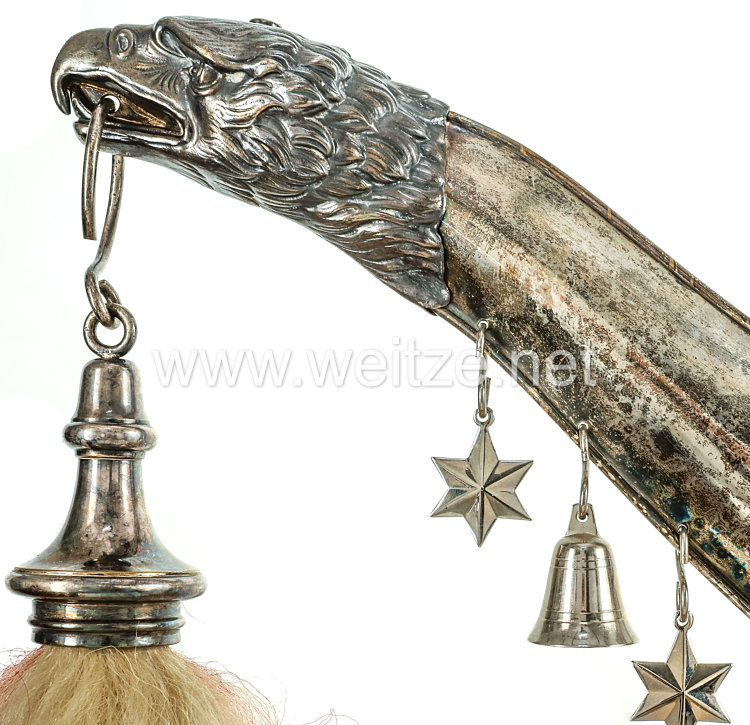
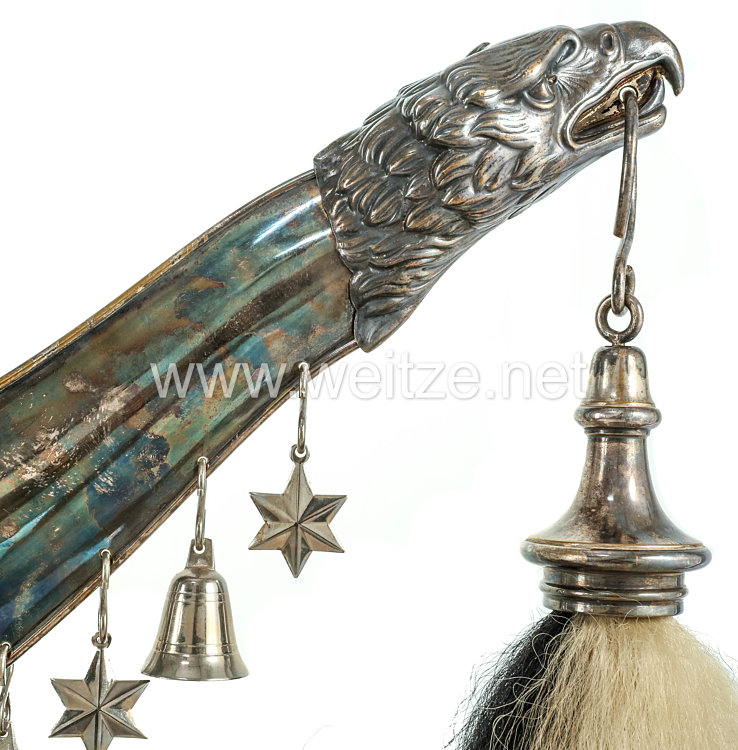
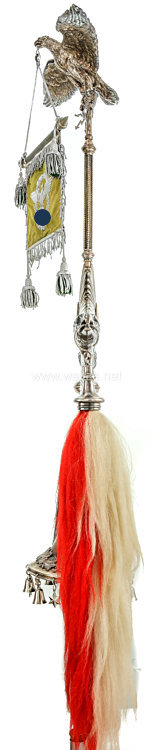
circa 1938. Large multi-piece jingling johnny (Schellenbaum), complete with all parts. At the top the Prussian eagle, standing on a cigar with lightning bolts. Holding in its beak the silver cord with the Schellenbaum cloth, which hangs from a crossbar. The cloth made of green silk, on the front side the national eagle of the Police in the new pattern from 1936 hand-embroidered in metal thread, surrounded by silver fringe, with 4 hanging tassels on the sides. Below it the large star, in the center engraved on both sides with the Prussian national eagle with swastika on its breast and the motto “Gott mit uns” (God with us). Below that the large crescent (center arm) with 14 attached bells and stars, the crescent engraved on the front with the designation: “POLIZEIPRÄSIDIUM ALTONA-WANDSBEK”. Engraved on the reverse “ÜBERREICHT VOM POLIZEI PRÄSIDENTEN PAUL KINKLER”. Engraver: “C.W. MORITZ” and “BERLIN.W. 1934”. The crescent ending at both ends in an eagle head, with the large streamers attached, left in the Prussian colors black/white, right in the colors of Hamburg red/white. Below that the large bell with applied oak leaf wreath, with 16 attached bells and stars. Complete with the original wooden staff. Total height 2.25 m. The Schellenbaum shows slight signs of use and age due to use and its eventful history, the Schellenbaum cloth has lost a few silver fringes. In good overall condition. The Schellenbaum is completely disassemblable and can therefore be transported without difficulty.
Extremely rare, in over 30 years this is only the 3rd original and complete Schellenbaum that we have been able to offer.
We have manufactured a solid base with holding sleeve for this piece, so that the Schellenbaum can be securely displayed.
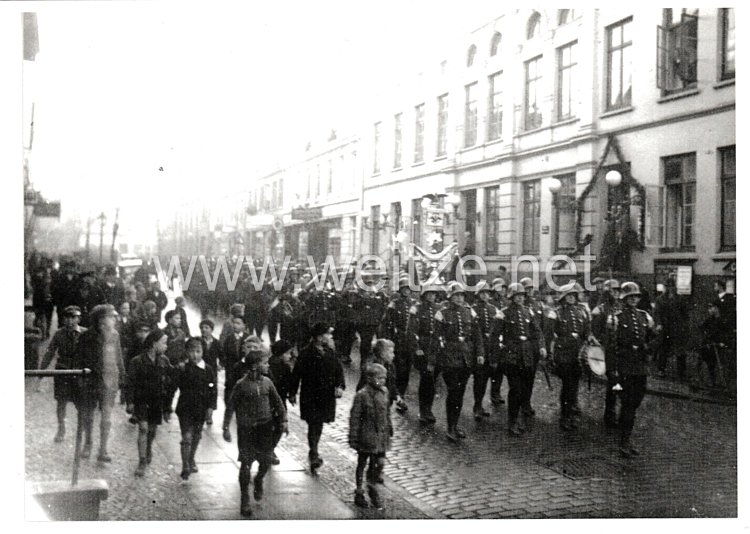
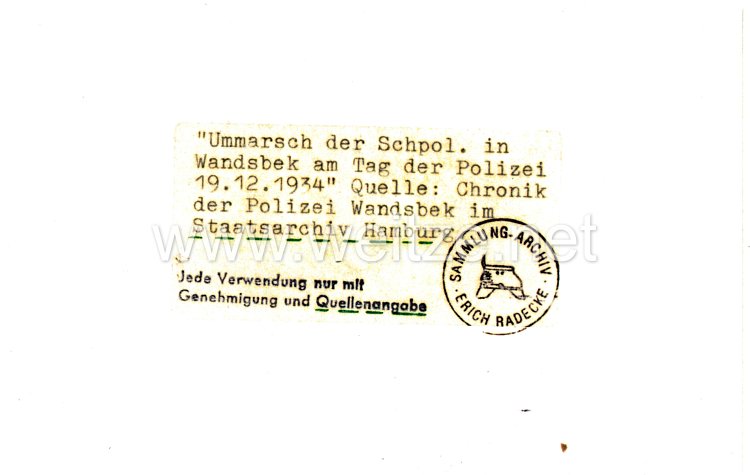
The Schellenbaum was acquired in the years 1933/34 for the Music Corps of the Schutzpolizei Altona-Wandsbek, which at that time both still belonged to the Free State of Prussia. Hence also the Prussian eagle on the star. With the Greater Hamburg Act of 1938, Altona and Wandsbek were incorporated into Hamburg and today still form the largest districts of the Hanseatic city. Attached as a copy is a fine photograph showing the Schellenbaum on Police Day on 19.11.1934 in Hamburg-Wandsbek, at that time still with the old Schellenbaum cloth.
358001
35.000,00

Third Reich Police: Large Jingling Johnny (Schellenbaum) of the Music Corps of the Schutzpolizei Hamburg Altona-Wandsbek

The Schellenbaum (jingling johnny or Turkish crescent) represents one of the most impressive and simultaneously rarest objects in German police and military history. As a ceremonial musical instrument and standard of the music corps, it embodied not only musical tradition but also the identity and pride of the respective unit. This example from the Police Presidency Altona-Wandsbek documents a particularly significant phase of German administrative and police history in the 1930s.

The tradition of the Schellenbaum dates back to the Ottoman Empire, where such instruments were part of Janissary music. In the 18th century, European military bands adopted these exotic instruments, which achieved great effect at parades and ceremonies through their imposing appearance and characteristic sound. In Germany, the Schellenbaum became an integral part of military and later also police music corps.

The Schellenbaum described here was manufactured around 1938 for the Music Corps of the Schutzpolizei Hamburg Altona-Wandsbek, although the engraving “BERLIN.W. 1934” indicates earlier production of individual components. The designation of Paul Kinkler as the presenting police president is of particular historical significance. The complex political and administrative situation of this period is directly reflected in this object.

Altona and Wandsbek did not belong to Hamburg until 1937, but to the Free State of Prussia. This explains the use of the Prussian eagle on the star of the Schellenbaum. At this time, Altona was actually the second-largest city in Prussia after Berlin. The independent police presidencies of these Prussian cities had their own music corps that performed at official occasions, parades, and celebrations.

The Greater Hamburg Act of January 26, 1937, which came into force on April 1, 1937, fundamentally changed the administrative map of Northern Germany. Through this law, Altona, Wandsbek, Harburg-Wilhelmsburg, and several other communities were incorporated into the Hanseatic city of Hamburg. Hamburg thereby grew from approximately 650,000 to over 1.7 million inhabitants and became the largest city in area in the German Reich after Berlin. The former Prussian police stations were integrated into the Hamburg police.

The technical execution of the Schellenbaum meets the highest craftsmanship standards. With a total height of 2.25 meters, it is an imposing ceremonial object. The structure follows the classical hierarchy: at the top sits the Prussian eagle on a cigar with lightning bolts, a symbol of Prussian sovereignty. The silver cord with the Schellenbaum cloth made of green silk shows the police eagle on the front in the form used from 1936 onwards. This change in the eagle representation occurred as part of the general standardization of National Socialist sovereignty symbols.

The large star bears the Prussian eagle on both sides with the traditional motto “Gott mit uns” (God with us), which harks back to Prussian and German military traditions since the 19th century. The crescent with 14 attached bells and stars displays the double inscription of the police presidencies Altona and Wandsbek as well as the name of the police president. The tails in the Prussian colors black-white and the Hamburg colors red-white symbolize the administrative transition situation and later integration.

The engraving by the Berlin engraver C.W. Moritz dates to 1934, indicating that central components of the Schellenbaum were manufactured before the incorporation. The Day of the Police on November 19, 1934, in Hamburg-Wandsbek, where the Schellenbaum was demonstrably used, was one of the great ceremonies at which such showpieces achieved their full effect.

Schellenbaums were not merely decorative objects but also had a practical function in the music corps. The Schellenbaum bearer marched at the front of the formation and set the tempo through rhythmic shaking and turning of the instrument. The bells and imposing appearance made the Schellenbaum the visual and acoustic centerpiece of every parade.

The rarity of complete and original Schellenbaums from this era cannot be overestimated. Most were destroyed, lost, or stripped of their NS symbols during the war or in the immediate post-war period. Completely preserved specimens with documented provenance are extremely rare and of high historical and museum value. They document not only artistic craftsmanship but also important chapters of German administrative, police, and local history.