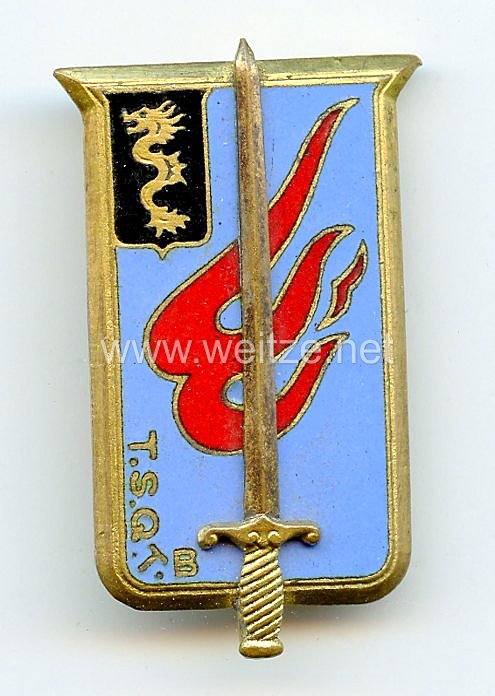
France Indochina Badge, Associated States “État associé”, Vietnamese Reserve Officers School “Thu Duc”
The badge of the Vietnamese Reserve Officers' School Thu Duc represents a significant chapter in the complex history of French Indochina during the transition period between colonial rule and the emergence of independent states in Southeast Asia. Manufactured by Drago Paris, one of the most renowned French producers of military decorations and badges, this object documents military cooperation during the era of the “États associés” (Associated States) from 1949 to 1954.
The Thu Duc Military Academy, located in the city of the same name northeast of Saigon (now Ho Chi Minh City), was established as the central training facility for Vietnamese officers during the late colonial period and the subsequent partition of Vietnam. The school played a crucial role in developing an independent Vietnamese officer corps, initially trained within the framework of the French Union and later for the armed forces of the Republic of Vietnam (South Vietnam).
The concept of the “États associés d'Indochine” emerged after World War II when France attempted to reform its control over Indochina. Following the Élysée Accords of 1949, Vietnam, Laos, and Cambodia received status as associated states within the French Union. This was a compromise attempt between complete colonial control and total independence. Vietnam was formally transformed into the État du Viêt Nam (State of Vietnam) under Emperor Bảo Đại, while simultaneously the Indochina War continued against the communist Việt Minh under Hồ Chí Minh.
In this political context, the training of indigenous officers became a strategic priority. The French colonial power recognized the necessity of building loyal Vietnamese military cadres who could be deployed both in combat against communist insurgents and in building state structures. The Reserve Officers' School Thu Duc became one of the most important institutions for this training.
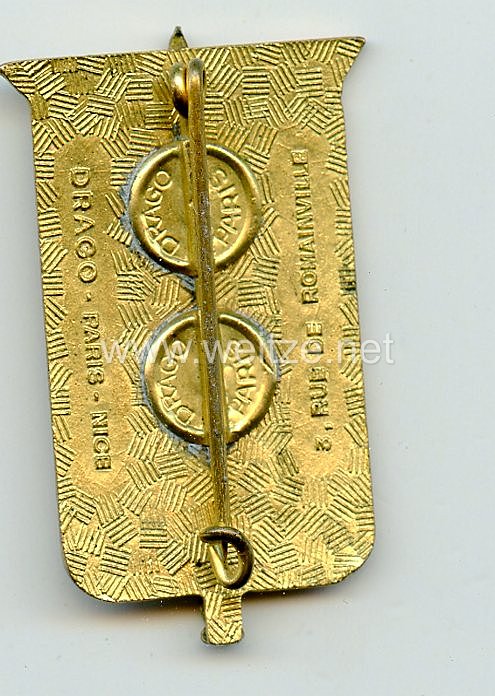
The manufacturer Drago Paris, with the address 5 rue de Romainville, was among the leading French companies for military insignia. The company, which maintained branches in Paris and Nice, produced high-quality badges, medals, and military equipment for French and allied forces. The quality and craftsmanship of Drago products made them sought-after collectibles. The manufacturer's marking on the badge confirms its authenticity and enables precise dating.
After the Fall of Điện Biên Phủ in May 1954 and the subsequent Geneva Accords, French colonial rule officially ended. Vietnam was divided along the 17th parallel. The Thu Duc Military Academy became a central training facility for the Army of the Republic of Vietnam (ARVN) under President Ngô Đình Diệm. During the Vietnam War, the academy remained operational until the fall of Saigon in 1975, training thousands of officers.
Badges like this were typically worn by graduates or instructors of the military academy and served as symbols of identification and pride. They documented affiliation with an elite training institution and the military professionalism of their wearers. The design of such badges frequently combined French heraldic traditions with Vietnamese national symbols, reflecting the cultural hybridity of this transitional period.
From a collector's and historical perspective, such badges are today rare testimonies of a bygone era. They document the complex military, political, and cultural relationships between France and Vietnam during one of the most turbulent periods in Southeast Asian history. The indicated condition 2 suggests a well-preserved specimen that has retained its original form and details.
These insignia are not merely military-historical artifacts but also documents of decolonization, the Cold War, and Vietnamese nation-building. They remind us of the biographies of officers who passed through Thu Duc Academy and played various roles in the dramatic events that shaped Vietnam between 1945 and 1975.