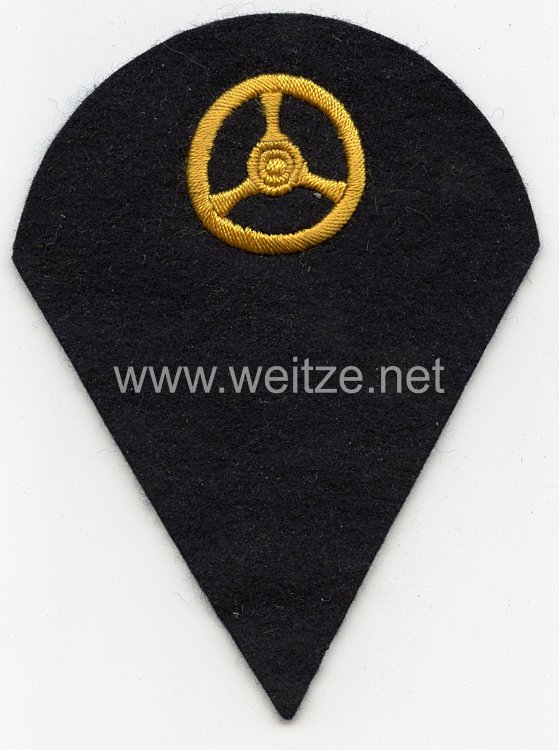
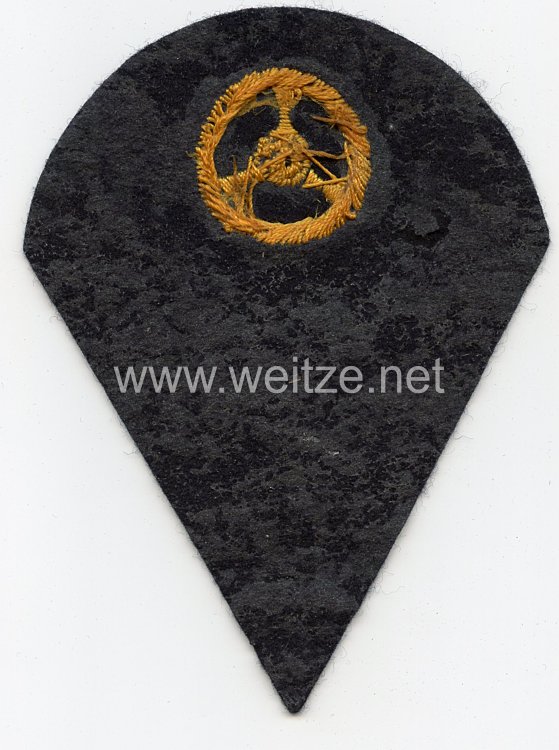
Kriegsmarine Enlisted Men's Sleeve Insignia Motor Vehicle Personnel Career Track
The Kriegsmarine sleeve badge for enlisted men in the motor vehicle driver career path represents a fascinating example of the specialized career insignia used during World War II in the German Navy. These badges served not only to identify specialized personnel but also reflected the increasing mechanization and specialization of maritime forces.
The motor vehicle driver career path (Kraftfahrerlaufbahn) within the Kriegsmarine may seem unusual at first glance, but it was an essential component of the naval organization. While Kriegsmarine sailors are primarily associated with seafaring duties, the Navy required a considerable number of drivers for land transport, supply of naval bases, transportation of personnel and material, as well as various logistical tasks on land. Naval ports, shipyards, training facilities, and administrative units all required an extensive vehicle fleet and correspondingly qualified personnel.
The Kriegsmarine sleeve badges were worn according to the Uniform Regulations for the Navy (Anzugordnung für die Kriegsmarine - AKM), first introduced in 1935 and updated several times. These badges were worn on the left upper arm of the uniform and identified various career paths and specializations. The motor vehicle driver career was represented by a characteristic symbol, typically containing a stylized gear or wheel, symbolizing the technical and motorized nature of this occupation.
The present example is a hand-embroidered variant for the Kollani, meaning for the Koll uniform or working uniform. The Kollani was the dark blue working dress of the Kriegsmarine, used for daily service and work duties. Unlike formal uniforms, this dress was designed to be more practical and durable. The fact that the badge is hand-embroidered indicates high-quality craftsmanship, possibly from a private manufacturer or tailor working for naval units.
The production of sleeve badges during the war occurred in various ways. While there were machine-woven and machine-embroidered mass productions, hand-crafted examples also existed, often of superior quality. Private manufacturers and tailors in naval cities such as Kiel, Wilhelmshaven, Hamburg, or Flensburg produced such badges for naval personnel who valued particularly high-quality uniform items. Hand embroidery allowed for finer details and more durable construction than machine-made variants.
The enlisted career paths in the Kriegsmarine were diverse and included, in addition to traditional seafaring areas, technical specializations such as radio operators, mechanics, medical orderlies, and motor vehicle drivers. After basic training, recruits were assigned to various career paths according to their aptitude and the Navy's needs. Driver training included not only operating various vehicle types but also basic maintenance and repair work.
The regulations for wearing sleeve badges were precisely defined in the Kriegsmarine. The career badge was attached to the left upper arm, approximately 10 centimeters below the shoulder seam. For petty officers and enlisted men, the badges were made on blue cloth for the blue uniform and on white cloth for the white summer uniform. The position and type of badge were immediately recognizable signs of the wearer's specialization.
The importance of motor vehicle drivers in the Kriegsmarine grew steadily during the war. With the expansion of naval bases along the occupied coasts from Norway to France and later in the Mediterranean, the need for logistical support increased considerably. Drivers transported torpedoes, ammunition, provisions, mail, and personnel between various facilities. They were also indispensable in the construction and maintenance of U-boat bunkers, coastal fortifications, and other naval installations.
The diversity of naval operations on land is often underestimated when considering the Kriegsmarine. Beyond the ships at sea, the Navy maintained extensive shore establishments requiring comprehensive infrastructure. Motor pools were maintained at every major naval installation, requiring skilled drivers familiar with military vehicles, regulations, and security procedures. These personnel wore the same basic uniform as their seafaring comrades but were distinguished by their career badges.
The hand-embroidered quality of such badges reflects the pride taken in military appearance and the tradition of fine military tailoring in Germany. While mass-produced items were standard issue, many servicemen purchased privately made badges and uniform items that were of superior quality. This practice was particularly common among career personnel who took pride in their professional appearance.
Today, such original sleeve badges are sought-after collector's items that provide insight into the organization and structure of the Kriegsmarine. They document the diversity of functions within the Navy and demonstrate that naval forces comprised far more than just sailors on ships. The hand-embroidered execution of such badges makes them particularly valuable to collectors of military historical textiles, as they often exhibit better quality and finer details than machine-made examples.
The study of such military equipment contributes to understanding the complex organizational structure of German armed forces in World War II and illustrates the importance of even seemingly minor functions to the overall operation of a modern navy. These small pieces of cloth and thread tell larger stories about military organization, logistics, and the human dimension of naval warfare.