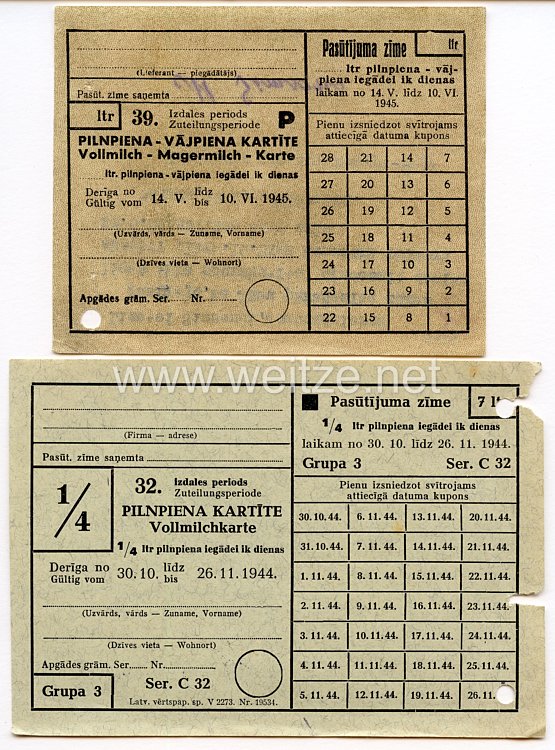
Third Reich / Latvia - Whole Milk Ration Card and Whole Milk-Skim Milk Ration Card from 1944-45

Bilingual printing in German-Latvian, used condition.
376900
50,00

Third Reich / Latvia - Whole Milk Ration Card and Whole Milk-Skim Milk Ration Card from 1944-45

The whole milk card and whole milk-skim milk card from the Reichskommissariat Ostland of 1944-45 represents a significant testament to National Socialist occupation policy in the Baltic region during World War II. These bilingual ration cards in German-Latvian illustrate the administrative integration of occupied territories into the German economic system under extreme wartime conditions.

Following the invasion of the Soviet Union as part of Operation Barbarossa on June 22, 1941, the Wehrmacht conquered the Baltic states within weeks. Latvia was completely occupied by early July 1941 and incorporated into the Reichskommissariat Ostland, officially established on July 25, 1941, under Hinrich Lohse. This administrative territory comprised Latvia, Estonia, Lithuania, and parts of Belarus, with its headquarters in Riga.

The system of food rationing had been established in the German Reich since the outbreak of war in 1939 and was systematically extended to occupied territories. Rationing served multiple purposes: ensuring supplies for the German Wehrmacht, maintaining civilian nutrition at controlled levels, and economically exploiting occupied territories. The Reich Office for Dairy Products, Oils and Fats coordinated the distribution of these vital goods.

Milk and dairy products were considered particularly important foodstuffs, especially for children, pregnant women, and the sick. The distinction between whole milk and skim milk on ration cards reflected the different availability and allocation of these products. Whole milk, with its higher fat content, was more valuable and preferentially distributed to certain population groups, while skim milk was intended for the general population.

The bilingual format in German-Latvian was characteristic of administrative practice in the Reichskommissariat Ostland. Although German dominated as the official language, many official documents, particularly those for everyday use by the civilian population, were printed bilingually. This facilitated practical implementation of rationing measures and avoided misunderstandings in food distribution.

The period 1944-45, for which these cards were issued, marks the final and most desperate phase of German occupation in the Baltic. In summer 1944, the Red Army launched its major offensive Operation Bagration, leading to the liberation of Belarus and the advance into the Baltic. In September and October 1944, the Soviet Union recaptured large parts of Latvia, with German troops trapped in the Courland Pocket.

During this phase of extreme wartime distress, the supply situation deteriorated dramatically. Ration quantities were continuously reduced, and even the amounts allocated on cards could often no longer be distributed. Infrastructure was severely impaired by combat operations, Soviet air raids, and the disintegrating German administration. Nevertheless, the occupation authorities attempted to maintain a functioning rationing system until the end.

The population policy of German occupation authorities in the Baltic was complex and discriminatory. While ethnic Germans and Balts classified as “Germanic” received preferential treatment, other population groups received significantly smaller rations. Jewish residents were systematically excluded from the rationing system and murdered. The Holocaust crimes in the Baltic cost approximately 250,000 lives.

Production and administration of these ration cards was carried out by local printing houses under German supervision. Cards were numbered and issued personally to prevent abuse. Individual sections had to be surrendered when shopping at assigned stores. The system required extensive bureaucracy with food offices, control points, and distribution centers.

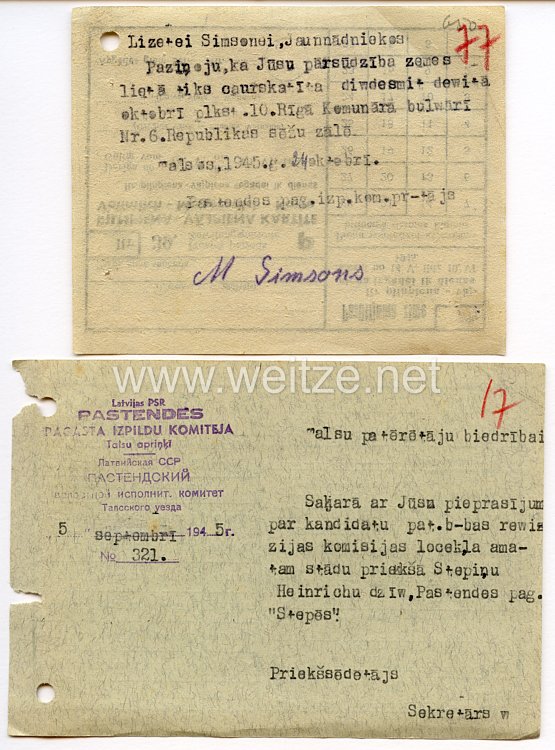
After the final Soviet reconquest of Latvia in May 1945, these German ration cards lost their validity. Soviet authorities introduced their own rationing system, which continued until the 1950s. Today, these documents are important historical sources for researching everyday life during the German occupation and World War II in the Baltic.

As collectible objects, such ration cards document the material living conditions of the civilian population under war and occupation. They testify to the total mobilization of all resources in World War II and the pervasive control of daily life by the occupying power.