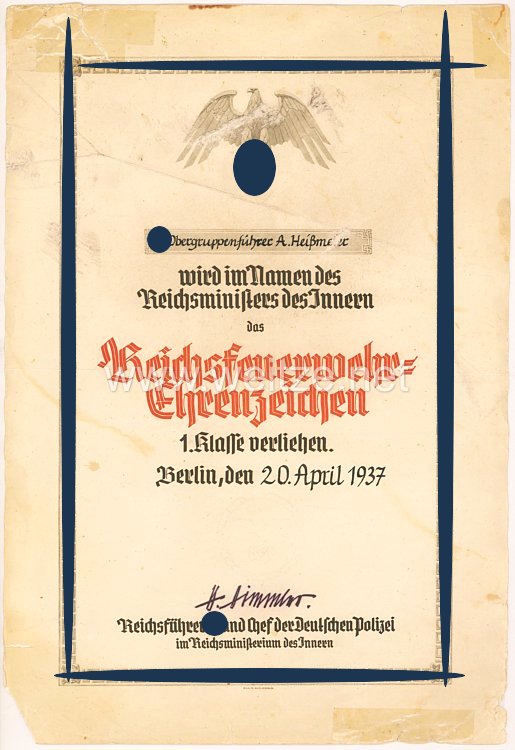
Allgemeine SS - Reich Fire Service Honor Badge 1st Class - Award Document for SS-Obergruppenführer August Heißmeyer

issued on April 20, 1937 with facsimile signature of Reichsführer-SS and Chief of the German Police Heinrich Himmler; large format 28.5 x 42 cm, with heavy signs of use.
https://de.wikipedia.org/wiki/August_Heißmeyer
366000
2.700,00

Allgemeine SS - Reich Fire Service Honor Badge 1st Class - Award Document for SS-Obergruppenführer August Heißmeyer

This award certificate for the Reich Fire Brigade Honor Badge 1st Class documents a significant decoration within the National Socialist honors system during the Third Reich. Issued on April 20, 1937, a highly symbolic date in NS ideology – Adolf Hitler's birthday – the certificate bears the facsimile signature of Heinrich Himmler as Reichsführer-SS and Chief of the German Police.

The Reich Fire Brigade Honor Badge was established by decree on December 10, 1936, and was intended to honor long-term and meritorious service in the German fire service. The decoration existed in two grades: 1st Class (after 25 years of service) and 2nd Class (after 10 years of service). The 1st Class Honor Badge was the highest level of this award and recognized particularly long-standing service.

The recipient of this certificate, SS-Obergruppenführer August Heißmeyer (1897-1979), was a significant figure in the SS hierarchy. Heißmeyer built his career both in the Allgemeine SS and in various party organizations. His career path included important positions in NS educational affairs and SS administration. The award of the Reich Fire Brigade Honor Badge to a high-ranking SS leader illustrates the close interweaving of the SS, police, and fire service following the National Socialist seizure of power.

The consolidation of German fire brigades under central state control was an important aspect of NS Gleichschaltung policy. With Himmler's assumption of police powers in 1936, the fire service was also integrated into the police system. This led to the creation of unified structures and decorations, including the Reich Fire Brigade Honor Badge.

The present certificate in the large format of 28.5 x 42 cm corresponds to the standardized dimensions for official NS award certificates of this period. Such documents were printed on high-quality paper and often designed with elaborate printing techniques. They typically displayed NS symbolism such as eagles and swastikas, along with characteristic Fraktur script.

Himmler's facsimile signature on the certificate was common for mass awards. As Chief of the German Police, Himmler was formally responsible for all police honors but could not possibly sign all certificates personally. The use of facsimile signatures was therefore standard practice for less senior awards.

The heavy signs of use noted on the certificate are not unusual for such documents. Many certificates were stored or transported under difficult conditions during and after the war. Some owners attempted to hide or destroy compromising NS documents, which could lead to damage.

After World War II, August Heißmeyer was initially not brought to justice and lived under a false name in the Federal Republic. However, his career in the NS state, including his role in various SS and party organizations, made him a typical representative of the SS elite who were deeply involved in the criminal system of National Socialism.

Documents such as this award certificate are important historical sources today for researching the NS system. They document not only individual career paths but also the mechanisms of honoring and binding functionaries to the regime. The award of decorations was an important instrument for creating loyalty and demonstrating the power and control of the NS state over all areas of life, including civilian fire protection.

The preservation of such documents in collections and archives serves historical examination and documentation, even though the honors documented therein originated from a criminal dictatorship. They help to understand the structures, hierarchies, and personnel of the NS regime and provide insight into the everyday reality of the totalitarian system.